FEATURED POST

50 Places To Catch Fish... Part 3

Showing posts with label bass. Show all posts

Sunday, May 8, 2022

THE STEALH BOMBER - A GO-TO PATTERN


 A Fleet of Stealth Bombers

I recently made a post on Palmetto Fly n Fish, talking about Stealth Bombers, again…. Yeah, once again. This is noteworthy, because until a couple years ago, I didn't give this pattern much notice. More like, I didn't give it ANY notice. Nevertheless, fast forward to now and, while I'm no expert Stealth Bomber pilot, I think of them as a must have pattern. Reasons to Have Stealth Bombers So what happened? Why do I like them now? According to Georgia's Kent Edmonds*, the creator of the pattern, the Stealth Bomber is a foam-based derivative of the "Turck’s Tarantula." 
Being a foam diver/slider, it duplicates the Tarantula’s diving motion and the resulting bubble trail made when the fly is stripped hard. * I once met Kent Edmunds, and had no clue who he was. I feel kinda bad about that, now. Sorry, Kent. Okay, fine. But what is special about the Stealth Bomber? Well, the Stealth Bomber..... ... features foam, hair, legs, and flashy stuff. The only thing missing is hackle, I guess, and there's probably some way to work that in, too. Otherwise, the Stealth Bomber has it all.
... floats in the surface film, not above it. This mimics what most real critters do; they float and swim half submerged. Many experts claim this increases hook-ups, and I'll take their word for that. .... marries a slider with a popper....but mostly a slider, since there's no popping face.
.... makes that desirable, but elusive, “quiet noise.” It doesn't 'pop' and 'kersploosh,' so it's less likely to scare away pressured fish. But it dips and dives seductively, which is likely to entice them.
.... leaves a good bubble trail in it's wake. This is a visual thing the result of that big, open foam loop at the rear. Your garden-variety popper doesn't manage this feature all that well.
With all this going for it, how can you go wrong? Looking back... I don't think I’ve ever cast one out, that failed to get attention from the fish. At The Vise The Stealth Bomber is also just enough of a challenge at the vise to be interesting. First off, it requires a precise shape for the foam. To make this shape consistent, you want either a purpose-made cutter, or a template. Either will do the job and allow you to knock out the correct shape, time after time. But, since I'm too cheap to spend $20 apiece for each different size foam cutter, I made a tracing template out of some old countertop micarta. Fortunately, Kent Edmonds makes the template available in .pdf, on his webpage. So that’s a good thing. You download the .pdf, print, and make a tracing template like the one seen below....
Tracing Template, size 6
You can find a link to the templates in the end notes.
What else? Well, the pattern is a bit of busy work, but not overly fiddly. It is a bit complex, too, but only enough to keep you honest and make you pay attention.
The Stealth Bomber is not a fast tie, but not painfully long, either.
And if you screw something up, it’s not a big deal to step backwards and correct it.
Take my word for that.
So, I like to keep in practice tying them. I’ve got them down to size 8, and probably wont go smaller. 
Between 8 and 6, you're right in the zone for bass and panfish.
Variations Unlimited Here's the another good thing about the Stealth Bomber - its flexible. The theme for this session was red…. because the foam I used was red. And people, they like red.
Fish, on the other hand,...well, I don’t think they care much about color.
But people, they like red. However any color will do, as long as you like it. Blue has some appeal to it, in my experience. I believe chartreuse is the most popular color. And certainly the old standards of black, green, white, yellow, orange, all these are bound to have some fans. And why not pink? Or Fire Tiger? Why not indeed?
I included lotsa legs, too, because I’m a leg man. I don't suppose it hurts to make it look "buggy" this way.
As you can see, the variations are probably only limited to what you have available. The construction is standardized, which lends itself to infinite subtle - and not so subtle - variations.
That also suits my FTADD*….. I’ve tied no two Stealth Bombers the same way, twice. Those shown here are no different. They are all within the theme, but each is a variation on the one before. * Fly Tyers Attention Deficit Disorder Fishing Notes This is what Kent says about the fishing the Stealth Bomber The originals were basic, and tied in black. But for bass and big bream, I often tie some in bright color combinations and add flash wings and rubber legs. The "stealth" name hardly applies to their appearance..., but its action can still be quite stealthy. With soft little strips it will wiggle and maybe "bloop" slightly. Strip with a just a little bit more vigor and it will dive and bubble, but still stay in the target zone (the strip here should be very quick, but very short). Give it a longer, harder strip and it will dive hard and create a major commotion. To learn more, go to the links at the end and get the template. It's all there.
So, yeah…. Stealth Bombers. Get you some.
Materials - recommended Hook - sizes 4-10, straight shank Thread - strong, because were working with foam Foam - 2 mm craft foam Tail - bucktail, synthetic poly "hair," Krystal Flash Underbody - dubbing, peacock herl, yarn, etc
Wing - bucktail, synthetic hair, Krystal Flash
Legs - rubber, silicone, stretchy legs - - - - - - - - - - - - - - - - - - - - - - - - Thanks for reading. I hope you liked it, and will share it with your friends. David
Visit Palmetto Fly n Fish, here: https://www.facebook.com/groups/flyfishingsouthcarolina © All rights reserved, 2022 End Notes 1. Kents page about the Stealth Bomber: http://www.flyfishga.com/stealth.htm 2. Downloadable template: http://www.flyfishga.com/The%20Stealth%20Bomber%20Fly.pdf

Monday, May 28, 2018

Flip Flop Poppers

The Flip Flop Popper

Cheap footwear into super fish catcher

By David Hutton
May 28, 2018

Poppers!

    Just the word makes most fly anglers sit up and take notice.
Some get antsy just thinking about poppers.


    Since E.J. Peckinpaugh and Will Dilg marketed the first commercial cork poppers in the 1920's, fly men and women have been using the venerable popper to catch fish. 
    Bass were the original targets of the popper, but today most any fish you can name has been taken on them, both in salt and fresh water.
    But we have come to think of them mostly as warm water flies for bass and, increasingly, bluegill. 
Today, few other fish are associated with the "popper" as much as these two.

Materials
    Many materials have been used for poppers, with one obvious requirement: it must float.
    The first poppers were made in the Ozarks in the late 1800's, from beer bottle corks and turkey feathers. Since then, cork has been the traditional go-to. Its a little heavy, but it is rugged.
    Balsa wood came into the mix in the 20th century prior to WWII. Its light, but can be a tad fragile.

    But these minor flaws aside, millions of poppers have been made from cork and balsa, alone. 

    But people like to experiment and try new things. 
    For instance, Louisiana innovator, artisan, and author, Kirk Dietrich, turns popper bodies on a small lathe using paulownia wood - a very light, fine-grained, and warp-resistant hardwood. The works of art he creates this way are testimony to this materials' ability to take a finish.

    But increasingly, expanded plastic foams have been used to the point where I'd say they now dominate the popper field. 
    First was Styrofoam, the trade name for air-injected polystyrene - the same stuff cheap ice chests are made from. 
It is buoyant, can be molded in many shapes and is, well, cheap. But it can be crushed easily and will melt if kept in contact with soft plastic lures and baits. 

The Solution
    Enter "craft foam," the generic name for ethylene-vinyl acetate (EVA). 

    The stuff is produced in a rainbow of colors and comes in everything from sheets, to rods, to blocks.
     It is tough as nails, can be easily shaped, and is practically impervious to anything you or the environment can throw at it.
For the man or woman who ties popper flies, it overcomes the limitations of Styrofoam, cork or balsa.

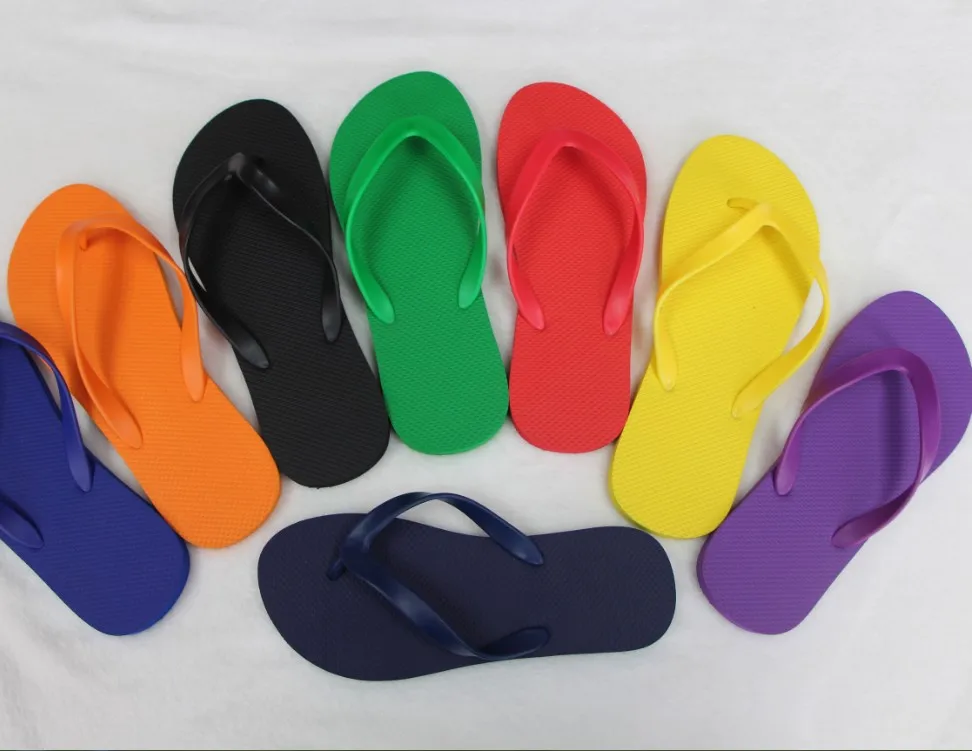
    And among the many things it is made into (besides flies) is possibly the least likely of fly tying materials - the cheap beach and pool sandal
Also known as, “Flip-Flops.”
    These can be found in almost every dollar, drug, and discount store in the country. They usually cost anywhere from 89 cents, to a few dollars for the fancy ones.

    I often find them floating along the shore, the mystery of their loss hanging over them.


Image result for foam flip flops 
Cheap Flip Flops

    But whether you buy them or find them, how do you make a cheap flip flop into a fish catching popper fly?

I first learned of this technique from fellow float tuber, Big Bluegill member, and Oklahoma man, Greg McBill. I'm adding a link to his input on the topic....
 

Greg McBill on The Flip Flop Popper

How I Do It
    I normally make my poppers for use on bass and bluegill, so I'm not making gigantic ones.
    I use either a sharpened piece of thin-wall, 3/8" stainless tubing, or a spent .357 Magnum cartridge casing. Pretty much the same thing.
    The idea behind this two-fish role is called, “The Bass Bluegill Lap,” and it started 
with the late, great Jack Ellis.
Guide and author Skip Morris has an excellent 2-part article on it here...

Bass Bluegill Lap 


    The cutter I've just described is forced down into the foam sole of the flip flop and turned gently as it goes in. 
I also chuck the cutter in a drill and spin it for a cleaner cut. Either way,  you end up with a pretty neat cylinder of the foam.

    Once the body cylinder is cut out, I sometimes lop off a piece of the rear at a 45° angle, to give the body a taper.
     You can also spin the body on a mandrill in a Dremel tool, and shape it with a sanding stick.
But, more and more, I forego the shaping and use the cylinder straight from the punch - the fish don't care, so shaping is just extra work.

    Once the body is formed, I use a sharp single-edge razor blade to cut a slit in the bottom to accept the hook. 
The hook I normally use for my poppers is a #4-#6 Carlisle (aka, "cricket hook"). 
    I bend a hump kink into the hook shaft with round-nose pliers, which prevents the body from turning around the hook shaft. Then, I wrap fly-tying thread around the shaft where the body will go. Finally, I position the foam body on the kinked shaft, hold it closed with a clothespin, and apply super glue to the joint. 
In a few seconds, it’s secure and solid.

The Forgiving Hook
    I also apply some round nose pliers to open the hook gap a little, and bend the protruding hook at a slight downward angle. 
    These hooks are classed as "light wire," which is adequate for bass and panfish with fly tackle. But, because they are heat-treated wire and not forged steel, they give you this ability to modify their shape.

    Here are two more good reasons to use these light wire hooks:

1. They pierce a fish's jaw easily.
2. They can be pulled free from snags


    If kept sharp, these hooks nearly set themselves.
    But sometimes they snag on wood and other obstructions. When that happens, just apply steady tension on the line and pull straight towards you.
    If you tie a good knot, and your tippet can take the strain, the hook will begin to straighten... and voila! It normally pulls free from the snag.

    Then, use your forceps or pliers to bend it back into shape and you're back in the game. Easy-peasey.

The Finishing Touches
    Once cemented on the hook, the foam body is decorated with dots, stripes - and eyes. I use plain old nail polish for this work. 
    You can decorate to your hearts content, as this is the "artistic" phase  - again, the fish don't care, but you probably do.
    Me, I keep it simple. But, do what you want. 

    Once you've decorated the body as you like it, a coat of clear nail polish finishes it off. That's it.

Say No To Epoxy
    How about an epoxy finish?
    It seems that nowadays, people simply must add epoxy to everything... and poppers are no exception. These folks chomp at the bit to mix up a batch of epoxy, or to whip out the ultraviolet flashlight for a UV coat. 
But I don't find it necessary with these EVA poppers. 

    The foam is bullet-proof, on its own, and it isn't harmed by smacking it into wood or rocks. So, it doesn't need a hard, epoxy shell for protection.
    It won't soak up water like natural materials, and it makes little difference to the function if it is not glossy. 
And besides, if an epoxy finish coat isn't there, well, you can't chip, ding, or knock pieces of it off.
    There is also a weight factor with epoxy, although that's probably negligible. But above all, its just easier to not fool with it. 


    With all that said, if you have epoxy withdrawals unless you smear some on, then use it. 
But you don't need to. 

The Dressing
    The tail dressing is the last step, and can be anything you want. Deer hair, squirrel hair, calf tail, rabbit or fox, bucktail...all these and more can be applied. 
    For feather dressings, marabou is an option, and the standard embellishment is 2 or 4 cheap, Chinese cock neck or saddle hackle feathers. 

    I've used them all, and I keep it simple....

1. Add a sparse tuft of deer hair behind the body, first. Tie this to the hook shank so it flares just past the bend; make it about a hook gap in width. In the next step, I'm adding hackle feather "legs" - and the deer hair helps hold them apart. 

2. Tie in 2 or 4 proper sized hackle feathers. These should be about hook shank in length. Tie them in on each SIDE of the hook, so the deer hair splays them apart.

3. Complete the dressing by wrapping another hackle in the gap between tail and body.

    How about rubber legs? Many folks just gotta have rubber legs on their poppers, and the fish don't seem to mind. Not that its required, mind you; long before rubber hackle came on the scene, people were catching fish without it. 
    But if you want to add legs, it is easy.


    Just push an embroidery needle threaded double with mono through the foam body, and pull it out to form a loop on the opposite side. Load the loop with the rubber legs and then pull them through. 
    See the illustration above.

    I like both round rubber hackle, or the silicone strands used to make spinnerbait skirts for bass. A tiny dot of super glue where the legs exit the body secures them.

A Few Pictures


Pond bluegill on a black Flip Flop Popper


Flip Flop Popper Chomp!


Assortment of Flip Flop Poppers

    The six from the top, down, are variations in decorating and size. The third one down is the black popper from the preceding fotos. It is still in my fly box, and has caught its share of bass and bluegill along the way....and is little worse for wear, today!

    PS the last two are poppers made from small cork indicator floats. Not the same, but still very nice

So, now you know. Try some Flip Flop Poppers yourself and see what you think! 

------------<~~>------------

Writers should strive for a job well done... even half-baked ones like me. So if you found value in this article, please like, comment, and share it. 

Do you want to add the catching flies seen here to your own fly or tackle box?
Do you have ques
tions, compliments, or suggestions?
If so, email me at
...dahutist@gmail.com


Thanks so much for reading, and...


Tight Lines,

Dave Hutton

© All rights reserved, David Hutton/Palmetto Fly N Fish 2018/2025

Saturday, May 26, 2018

Of Sleeping Late and Fuzzy Nymphs

Of Sleeping Late and Fuzzy Nymphs


The air is muggy; a weeks worth of rain has left the ground soaked and spongy. 
What's worse, weathermen and facebook pundits say we're in for more of the same. 

And after the work week I had, sleeping til noon on a rainy morning sounds like a good plan. But, my eyes pop open, and 7:00 am will have to do. 
I look at the clock and groan; hey, it beats my usual 5 o'clock in the morning.

After making the coffee, I look outside and see it ISN'T raining right now. Seems like a perfect time to mosey down to the neighbors pond, aka, "Fly Lab II," and wet a line.

Yes, I really do mosey. This is South Carolina, after all. 
People here mosey.

The Season is Here
Approaching the pond, its obvious Spring is well underway. The surrounding grass is high and lush, the underbrush has grown to choking fullness, and the pond is sporting a fringe of green algae weed. The tadpoles of a few weeks ago are now conspicuous by their absence.

However, dragonflies are out in force. Their darting flight and swooping moves create a flying circus all around. I count a number of types I recognize, and one or two that are new to me.

The big boys of the bunch are the Rusty Dragonflies. These guys span your hand with their wings and you can hear their humming as they power by your head.
Small blue damselflies flit here, and there, their black, helicopter wings beating the air.
Swarms of very small dragonflies, the size of a thumbnail, well, they're new to me. 
My favorite, the Eastern Whitetail Dragonfly, makes a welcome appearance. 
And I watched, fascinated, as a 2" green female dips her abdomen and deposits eggs among the algae weed.  

Warmth and a lot of rain have transformed the pond and its environs into a new place, and I wonder if the fish are still here. 
As if in answer, a large, "KERSPLASH"  is heard from across the pond. Something has blown up the water in the far shallows; something is chasing something else, over there, and I mutter to myself, "Well, well, and hello. Lets get to it!"

The Business At Hand
Today I'm fly fishing. I've brought an assortment of flies, seen here


They are, from top to bottom:

1. Flip Flop Popper (black)
2. Old Faithful Popper (green)

3. Moodah Poodah (tan)
4. Casual Dress nymph (left)
5. Mink and Pheasant (a Casual Dress variation, right)
6. Bullys Bluegill Spider
7. Reverse Tied Black and White Soft Hackle


I tie on "Old Faithful," a small, #10 popper I've had for, well..., come to think of it, I don't really know how long I've had it.
It has been repaired a few times, has had a couple of color changes and dressing versions, and it keeps on popping along. Today it is chartreuse, with a faded red mouth, leering eyes and a jaunty feather tail of tan Indian neck hackle. 


I un-spool some line about the length of my 9 foot, 5 wt. fly rod and prepare to cast the fly. 
Ready....set.... and.... STOP!
I'm tangled up in the leader. I have to put casting on hold while I first sort out the mess. 

Its like that in fly fishing.

You get all ready, everything is set, but you lose just a split second control of the line. 

Then, it's BAM! and you've got a mess on your hands. 
Something they don't tell you about in fly fishing is you need patience and a cool head. 
Don't do anything in a hurry with the long rod. 
I suppose this is why only a few people do it well, and for very long. To coin a phrase; "if it was easy, everyone would do it." 

Back To The Business At Hand
It was just a minor tangle (as tangles go), so I was soon sorted and back at it. A swirl of the rod tip, a few flicks of the wrist and voila! the line was stretching toward the far corner of the pond and Old Faithful was back on the water where it belongs.

And that's pretty much were it stayed.
Untouched by fishy mouths.

Its also like that in fly fishing. What you think is gonna work, well,... it doesn't.

Over there, look - it's my perfectly good popper, floating all buggy and googly-eyed! 

I can see it, and I gently twitch it.
stall it, waiting.
I pop it.
I wait some more.
I make it dance a jig.

And the quarry ignores it. The game is a bust.
Every other writer and fly man in the world seems to be filling their creels on these "bugs," and I get nothing. 
Not even a courtesy swim-by.

Well, something else you learn to do in fly fishing is adapt.

"Alright you buggers, if the popper wont do - lets see what will."

I tie on a Mooda Poodah, which is a craft foam and deer hair, bug-thing with rubber legs. 
"What do you think of THIS?!" I shout, and cast it back into the same spot. And that was the trick.

The fly sat for a few seconds, quivering, legs dangling. Then, there was a splash, and it was taken under, savagely. The line straightened out and I was dumbstruck. 

But in fly fishing, you have to be ready for this. 

I woke up, grabbed for line and started stripping. 
I got the situation under control. The rod is bent, the fishes weight is felt.
At that moment, a 1lb. 'rocket bass' leaped from the water, flew about 4 feet and tore off across the pond.  This was more like it.

Now, I know a lot of you like to see bass flying through the air. That big head flailing, those red gills flaring. 
Why, the more aerial displays, the better. 
But I'm the opposite. I try to keep them below as much as I can, with tension firmly maintained. 

"Keep the hook in their mouth, not waving around with their head, out of the water" - that's my motto.

And I did exactly that. 
And that feisty 'green trout' still managed an LDR (long distance release), despite my best effort to the contrary. 

Just like that, the fish was gone and a
ll I got back was the fly. 

At that point you say, "Sometimes you catch them, and sometimes you don't."
The fly was taken, the fish got hooked (briefly), and I got my fly back. That's a good start.

Working the Water Column
I wasn't planning to be there all day; in fact, I only had about 45 minutes to fish. If I was going to work the water column, from surface to the bottom, it was time to switch up.

"Okay, the Moodah Poodah caught a fish," I said. "But, I've fished them for a few years; that's old news. Let's see what we can do below the surface, with something new."

Because I also tie my own flies, I usually have an assortment of untested ones ready to try. I reached for my fly holder and took a look at the offerings. 

Besides the poppers and surface bugs, I also brought along a couple of sub-surface nymph and soft hackle patterns to test out. 
I took one of the "Casual Dress" patterns loose from the holder.

The Nymphs Are the Ticket - Again.
Something I've learned from this freshwater fly fishing business is this: If you're not fishing nymphs of some sort, you're missing fish.
They don't have to be exacting mimics, either. Representative of the type is enough. The "Casual Dress" nymph is of the latter sort. 

Its tied from muskrat hair and a little ostrich. This makes it fuzzy, wiggly, and, well, just plain nymph-y. Natural fur is arguably the best material for these flies.

And the fish were nailing them every second or third cast. They liked a slow retrieve with a sink-and-quick lift. Their take was either a rip-snorting snatch and run, or a gentle heaviness in a sideways direction. 


Nymph Mouth Rocket Bass

I also noticed something unexpected with the Mink & Pheasant version of this nymph. Call it one of those, "Ah-ha moments" that often happens.
The M&P nymph, like the Casual Dress, is a hair-and-feather job. What happens is, it dries out a good bit during line-out (false casts), and then floats for a while in the film. It then submerges to fish wet.

But, while it was still at the surface, I noticed fish were coming up to slap at it. I assume these are bluegill, as this "smack and stun" trick is the bluegills M.O. They do it to knock the wind out of bugs that hit the water; they then come back and pick them to pieces. It was the only sign of bluegill I saw.


Mink And Pheasant Nymph

I also fished the one soft hackle I had, a Black and White Reverse Hackle.
It's a body of heavy black thread, ribbed with krystal flash, and a collar of reverse tied fibers stripped from a hackle feather.
It's a very basic fly, but very adaptable and a good fish catcher. 
It is also a way to use the cheap, non-descript hackle feathers that might otherwise be too long for the hook size you're using. 
I'll detail this one in another post, so make sure you subscribe.

Soon, it was time to go and get busy with the days non-fishing business. We need new tires on the car, preparations for the family Memorial Day are in the schedule, and .... well, there seems to always be something else.

But that's okay. At least I got to sleep in.

Tight Lines and Thanks,

David

Don't forget to subscribe and leave a comment.
David Hutton, © 2018
Palmetto Fly n Fish On Facebook


Saturday, May 19, 2018

Bob Clouser on Bass Fly Fishing


Bob Clouser Seminar - Bass from Top To Bottom

Atlanta, GA
Feb 3, 2017

I had the pleasure of sitting in on Bob Clouser's bass fishing seminar in Atlanta last year, part of the annual Fly Fishing Show held there. 
Bob is a big, bear of a guy from Pennsylvania. He has a full, white mustache, little hair, and a stout “Yankee” accent.
It's fun to just be in his presence and to listen to him. 

In attendance were also two stalwart members from our facebook page, "Palmetto Fly n Fish": Gerry Korzi and Donald Schmotzer. 

It's not everyday you get to sit down with a legend, so I took as many notes as I could.
Following are highlights of Bob's talk. Some of it may surprise you...

--------------------------------------------


We come in a bit late, and enter an already darkened room. Bob is in front of a projector screen, manning his laptop and running a slide show. About 40-50 people are seated, theater-style, facing him. He's talking about tackle...

“Alright fellas, lets talk about tackle for bass.

Rods
Now, I'm a pro staff angler for TFO, so naturally I'm gonna promote their products. They are high quality and reasonably priced.
But when most people talk about bass on the fly, they mean 7-9 weight rods. 
And I wanna say right here - that's not really necessary. 
Today's modern materials and designs give most 5 wt. rods the strength needed to handle bass. 

The main issue isn't the fish, anyway – its the bulky, air-resistant flies everyone thinks they need to throw at bass.
So lemme ask - how many of you guys use 5 wt. rods? 
(a few timid hands go up)

Hey, its alright – rod manufacturers will tell you the most popular rod weight in the country is a 5 wt. 
This is followed by the 4 wt. 
Then the 6, 7, 8 and the rest.
So, how many of you fellas want to keep using those 5 and 6 weight rods? 
(this time over half the crowd raises their hand)

I thought so. And who wouldn't, right? It's what you're used to.
If that's the case, start tying your flies on bend-back, or worm style keeled hooks, and tie them somewhat sparse. These flies aren't big and bulky and me and Lefty* have been working with them for years.”

Here he shows a picture of flies tied with a pronounced kink behind the eye. The shaft makes a near 90 degree bend for about 3/16-1/4”, then bends back in the same line, but now below the original plane. It looks very much like a worm hook, and he places the eyes right in the kink.

* This was before the passing of Bob's longtime friend, and fly-fishing great, Lefty Kreh.

Bob goes on to speak about lines...

“Line
I wont say too much about floating lines, but I will tell you to have floating AND sinking lines. 
The best sinking line? Type 3.
It doesn't sink too deep, or too fast, and this lets you control the fly better.

Adding Weight to Flies
If you need a deeper presentation, you'll be thinking about adding weight, right? 
That usually means using split shot, to get the fly down.
Well, don't – use Twiston lead strip weights, instead.

Split shot tends to snag and drag, or you gotta get into tricky shot droppers, and so on. And you have to fumble them out of little baggies, or tubes or whatever, to use them.

Instead, the Twiston lead wraps come in a convenient pack like a book of matches. You wrap them around the leader and line and they present nothing to get lodged between rocks or snags.

Use Loops
Your line and leaders should use looped connectors – there's nothing to go wrong with a loop. Enough said about that.

Leader
Don't get too long here; 5-6 feet is enough. 
It doesn't need to be tow-cable thick, either. 
Just a standard thickness that matches the line, and stiff enough that it allows the line to turn the fly over. 
This is because your tippet is actually the key...

Tippet
Make your tippet long. 
Bass aren't terribly line shy, but they can be. 
You wanna get the fly well out and away from the line and leader, using a minimum tippet length of 3 feet!
You'll catch more bass this way.

Knots
There are only two knots you need to know for attaching flies to tippet.

- Lefty's Non Slip Loop Knot
- Improved Clinch Knot

Don't worry about others.”

I give a silent cheer and nudge Gerry Korzi, whispering, “This is great! I'm not smart enough to know a dozen knots, and have been using these for a long time.”

Back to Bob...

“TOP WATER
Lets first clear something up - the 'top water bite' is a myth, fellas 
(A murmur goes up and people squirm uncomfortably at this).

I know what you're thinking, but in general, fish don't normally loaf at the 'top' - the surface - waiting for your fly or some other juicy tidbit to land in their face. 
They're too exposed that way and it goes against all their instincts. 
Instead, they stay below and COME UP to the surface.
Think about it; how many times have you seen that – the fish isn't literally on the surface, but comes out of nowhere from below and grabs your fly? 
(the audience nods its head in unison)

I remember one white fly hatch so thick, you couldn't breathe without gagging on bugs. The bass were hungrily feeding on the flies - but they were only taking every fifth fly. 

They would come up and take a fly off the surface, go back below to their safe spot to gobble it down, and then come back up once they felt safe enough. 
During  the time it took for this to happen, four white flies had gone by!

The point is, they are exposed at the surface and they don't like it. They may be NEAR the surface, yes, but they are not normally right in the film. 
Another way to look at this is to say they'll maybe feed up, rising to the fly.

Surface Presentation
Bass that are willing to feed on the surface and take a fly, might be somewhat particular, however. 
They either like noisy flies, or not. And you gotta figure out which.
When they want a quiet presentation, don't give them a noisy one...you'll put them down.
If they'll accept a noisy surface bug, great - give that to them.
But you'll have to start out with slow, gentle presentations first, or risk scaring them off.

This means cast the surface fly and let it sit.
Twitch it, maybe.
Let it sit some more.
Move it slightly, let it sit again.
Repeat.

If that doesn't work after numerous attempts, get more rambunctious with your retrieve and imparting action until you start getting strikes.

Poppers
Who likes poppers? 
(all the hands shoot up)
Well, when it comes to poppers, we used to use cork-bodied versions back in the day, and did well with them. 
Then foam came out, and we all thought it was wonderful. So many colors, easy to work with, and tough as nails; the cork can be a little fragile, after all. 

Sounds perfect, right?
It's not.
Foam has a problem. 

Both Lefty and I found our foam poppers don't get as many strikes as the “corkies.” 

After a lot of study, we figured out what was going on:
The old cork bugs sat lower in the water!

Cork is buoyant, but not like the foam material. By contrast, the foam jobs ride right up on the surface which is kind of unnatural.

To cure this, what I recommend you do is cement a piece of thick solder or lead wire into the slit you make in the foam popper bodies when you glue in your hook. 
Experiment a little until you get the weight right, ensuring your bug bodies float half in, and half out, of the water. 
You'll get a better sonic effect and I'm sure the fish will more readily take these modified poppers

But I think there are better surface flies than poppers, in my opinion, and these are the skippers, chuggers, sliders and so on. They present a more natural appearance in the water. You should give these serious use.

Near Surface Flies
Another class of 'top water fly' isn't really; it's what I call the 'near-surface' fly. 
These run from right at the surface to a foot or two down. 
This is the suspending fly, the one that doesn't sink fast.
It kinda hovers on the drop, instead. 
You can do as well with these, and maybe better, than with top water flies. 
A favorite of mine has a three layer head of red - white - red hackle in front, with a white Deceiver-style back end.

FISHING HEAVY COVER
Here we're talking about lily pads and thick weeds, guys. This is a favorite place to fish for bass.

My advice, though, is to ignore this stuff except under the best conditions. By that I mean, when the wind lays down and the water is calm. 
You want to work back into the pockets and holes in the weeds, but its almost impossible to be in control of your line and fly in this stuff when your line is drifting all over, the boat is drifting all over, or everything is being blown around by the wind.

Weed Guards
How about those weed guards? Everybody loves these things, and so do I.
They keep your fly from hooking on everything... including fish.

My favorite type of weed guard is the side-by-side wire or mono type. But – and its a big but - I trim their length so they just barely protect the hook point, right to hook point length, in fact.

Shallow Cover
I also advise you guys to fish tight in to the shore cover, often.
How many times have you gone down near the shore and seen the wakes of fish taking off like scared rabbits at your approach? 
It's happened to all of us, I'd imagine.

Well, you'd be surprised how often decent sized bass are right in tight to shore. This will usually be in the presence of some kind of cover, most often weeds.
They may not all be trophy bass, but you should hit every pocket and point in the shore cover, as long as there is plenty of it around. Stick ups, too.

The lone stick or bit of grass poking up usually has a more significant structure beneath the surface, and fish will try to hide in amazingly sparse shelter.
In fact, if a fish can hide his head, he thinks he's safe - even if the rest of his body is exposed!

Because of this, a good tactic near shore is to use your polarized sunglasses to look for the tails of fish within the cover. 
If you see them, don't cast right at the head – or even beyond it. Instead, cast to the side, away from the tail. 
If your eyes aren't playing tricks on you, and a fish is really there, he will know your fly is there, too. 
And if he wants it he'll come to get it.
Casting at his head or dropping your line over his noggin' is just gonna send him running.

Frogs
Around heavy cover, USE FROGS. 
I cant stress that enough. 
I think bass spend their lives eating frogs.
Cast these right along the shoreline and cover, too. 
Bass fishing means accurate casting. 
I'd recommend quieter frogs over noisy ones, too, most of the time. But if you're not fishing frog mimics around heavy cover at least part of the time - you're missing fish.

DOWN DEEP
When fish aren't coming to the surface, and arent shallow, you have to go deep and that usually means near the bottom.
In rivers, its dead drift along river bottoms. 
In lakes its working a fly along the bottom.

Flies for this are patterns that imitate crawfish, sculpins, darters, worms, etc.

Mending the Drift
When deep drift casting on rivers, make your mends in the air before the line lands in the water. 
Let the line shoot out and give it a sideways up-current flip before landing. This puts an upstream loop in it. 
The point is to let the fly settle in place once in the water, not to be dragged around by tryin' to get the mend and drift just right. 
Bass will often hit the fly just when it enters and begins to float down. If its being hauled all over by your line gymnastics, it may put the fish down more than attract them. 
It also lets slack get in the line.

And you want to keep the slack out of your line! 
Follow the line on the drift with you rod tip and strip in line to eliminate slack. This rule is universal. 
NEVER let the line drift in behind your rod tip – it should always be to the front, your rod tip pointing at the fly and you should not let slack develop.

The Reel
When playing fish, forget the reel. 
How many of you have had a fish get off while trying to reel in slack and get the fish onto the drag so you can, “play it”? 
You have this big money reel with its disc drag, and by God, you're gonna reel that fish, right? 
Sorry, but that's your mistake fella's
(more muttering from the crowd....).

Rather, keep stripping line and don't fiddle around trying to get the fish on the reel.
What happens is that while you're frantically trying to reel in slack, the rod tip is bouncing up and down - sending slack waves down the line toward the fish. Given half a chance, that fish is gonna get off.

The point is to maintain tension at all times, keep stripping, and don't let any slack develop with the fish on.
If the fish needs line to run, let the line out through your tightened fingers and manage it that way. 
If the fish is that damn big, its gonna get on the reel soon enough, anyway!

Be A Line Watcher. 
Bass don't often grab a fly and try to snatch the rod from your hand. It sometimes seems that way, but the fact is this: by the time you realize a bass is on, it has probably had your fly in its mouth for some time. 
Very often they pick up a fly and reject it before you even realize it happened.

Frequently, they grab the fly on the drop, or when you stop stripping and there is no real tension between you and the fly. 
And since the fly is coming towards you on the retrieve, odds are very good the bass is following – and moving towards you, too. Thus, it picks up the fly while also moving in your direction, on a slackened line.

This means the single best way to know whats happening is by watching the line where it enters the water. You must not let gross amounts of slack develop; if you do you'll miss the subtle twitches, stalls, and sideways bumps the line may exhibit when the bass engulfs your fly.

NOTES ON FLIES
Red and white still remains a productive color combination after all these years.
It doesn't seem to scare the fish or put them down, as you might think – in fact, they often seem to prefer it. The red and white hackle fly I already mentioned is great and I'll say it again, it works!
You can also work red and white into other patterns, like Clouser Minnows, for example.

Other Colors
A few other colors that seem to appeal to bass most of the time are these:

  • Olive over yellow, w/ gold flash. I don't know what it is with this combination but its another fish taker. Tie a sparse Clouser Minnow with a yellow belly, gold flash center line and olive top.
  • Gold, too, just seems to be a bass magnet in any form. You should try to work it into your bass flies wherever possible.
  • White belly, green side line and brown top

UV2 Materials 
In recent years, UV enhanced materials have come on the scene.
These have been touted as some sort of cosmic beacon to fish. 
They aren't. 
What they will do is brighten the fly, especially under reduced light conditions. 
So for flies intended to go deep or to be fished under low light conditions, UV2 is a good idea.

Steve Farrar Flash Blend
If you've never heard of Steve Farrar's “Flash Blend,” its time to change that. This stuff is almost magical the way it swims and adds attractiveness to a pattern. 
I recommend it highly.

Whenever I fish with Lefty Kreh, I always end up begging one of his flies. As good as mine are, his seem to be better. And he always obliges my request, because he brings along extras.
And he always charges me $5 per fly, for the privilege.

Stewardship
On a final note, I'd like to tell you about a lovely lady I've had the pleasure of fishing with for years. One day she caught a nice fish and wanted to take it home to show her mother.
“Why do that?” I asked. “By the time you get it home its eyes will be waxed over, its scales will be falling off and it'll look pretty ragged. 
Why not take a picture and let it go? That way, it can breed and make a thousand more babies for you to catch in the years ahead.”
She liked that idea.
The fish you save today is the sport you enjoy tomorrow.

The Crippled Minnow
And last but not least, someone asked why I haven't mentioned my own, "Clouser Crippled Minnow." 
Well, it's too damned good, that's why. 
Fish take it so hard and fast they get it deep, and I was seeing a lot of wounded fish, often mortally wounded. 
So I quit using it. 
It's kind of a secret weapon, but for the wrong reasons. 
I don't recommend it any longer.

Have fun and tight lines”

- Bob Clouser

I hope you enjoyed this. Remember, this was from memory, and my notes, and is not a direct appropriation of Bobs work. 
With luck, though, you learned more than you bargained for.
If you liked it, please share it with your friends

David
Palmetto Fly N Fish

Comments? Feedback? Opinions? Let er rip!
And don't forget to visit us at: Palmetto Fly n Fish

Tuesday, May 1, 2018

Bob Holland


BOB HOLLAND

I had a good chat last week with Bob Holland, up there in Wisconsin. Well, I say "chat," but I mean text session. Thats how it goes these days - we text as much as we speak.


So, I'll say we had a bonding moment, and leave the term, "chat" to your interpretation.
We talked about ultralight fishing and gear, and Bob was especially interested in small lures for light tackle fishing this summer.
This means light weight spinning for small bass, what I call "rocket bass." Basically, he wanted ideas for fishing artificials, instead of bobber watching. And he wants to use 4 lb mono... that is a sporting fellow after my own heart!

NO FRILLS
I didnt break any rules or suggest the latest "revolutionary" bait for Bob...
"Pretty much the same stuff you’d use for bigger bass," I said:

  • Micro- and mini-crankbaits
  • Small weedless spoons
  • Small in-line spinners, 1/16-1/12 oz
  • Beetle Spins, size 1-3
  • Mini poppers, like the small Hula Poppers available today.
  • 1/8 - 1/32 oz jig heads and twister tails
  • 1/8 oz Sliders (a fave)
    BEETLE SPIN 
    You'll notice I included the Beetle Spin in that list, and it turns out Bob is also a fan, too. He calls em, "easy to fish," and I cant say I disagree.
    Its probably my single, most-used spinning lure in the warm season.


I have tons of other lure types; boxes full, to be honest. But when I reach in my tackle bag, I usually have to make myself choose something else.
They're easy to cast, almost impossible to fish wrong, fast or slow, and they tend to shrug off snags. I wont call them snag-proof, but they can be bumped and knocked into rocks and wood without too much worry.

The little grub bodies can be mixed and matched with different blades, and you can add rubber legs to them by pulling the strands through with a needle. These often get strikes when the plain ones don't.
Finally, you can buy a Beetle Spin with a couple of extra grub bodies in an array of colors, for a dollar or so.
Versatile, with a capital, "V" applies to the Beetle Spin.
You can hardly ask an artificial lure to do more. Old Virgil Ward had a good one one with the Beetle Spin.

SLIDER
Our discussion also gave me the chance to remind someone about Charlie Brewers, “Slider.”
Do you old timers remember the Slider? Today, its called the Crappie Slider, and is sold in sizes that appeal to those fish. But other fish, including bass – especially bass - will take them.
More on that in a minute.
So, if youre too young to know what a Slider is, well, here's the general idea.


Actually, the Slider is a pair of items: a hook-and-soft plastic combination. Each is a fish out of water without the other, you might say.
The hook is unique, as it is shaped like a bass worm hook, but with a broad, lead head, like a jig.
The Slider "grub body" has a ribbed front half with a squirmy, disc-shaped paddle tail that wiggles if a fish even farts near it.
So, add a very soft plastic body with a seductive tail, on a sorta-Texas rigged hook. But, they are smaller and lighter in weight than most bass lures, and it fishes slow.
And that's slow spelled, "S-L-O-W." 
That really was Old Charlie Brewers technique – he called it, "Do Nothing" fishing. He fished his Slider creepingly, agonizingly slow. The lure was crawled and worked across the bottom and over obstructions like a living thing, in no hurry to get anywhere. ,
He said if your reel handle makes more than a full turn in 30 seconds, you're working it too fast. "Its harder to fish something that slow, than to crank em fast," he used to say.
Here's the kicker - He won a lot of tournament money with it in his time.
Today, it's a safe bet not many fish have seen em.

My first experience with the Slider is a bit different than one might expect. It lead to the first spotted sunfish I ever saw, lepomis punctatus, which came out of Langley Pond in Aiken, SC on a homemade Slider hook.
I had never seen a genuine Slider hook at that time, but that wasn't going to stop me. I figured I could make one; and it wasn't hard. With a chartreuse twisty tail grub, I pulled that big spotted sunfish right out of some tree roots by crawling my ersatz Slider through its tangled lair.
Yes, I just recommended a crappie lure, that catches large sunfish, for rocket bass. Put those three together, let it percolate, and the question becomes obvious: Why are you NOT using Sliders?

FLIES
As we both love fly fishing, in addition to spinning, we eventually got to flies. What he was most interested in is small streamers for the bass in his local ponds and rivers. We brainstormed up a couple flies to cover the water, again without shaking the pillars of the earth in the process.


- Clouser Deep Minnow
This classic fly needs little introduction, Some bucktail on a hook, with dumbbell eyes, that's pretty much it. I like to work a little marabou into the tail for movement, but I try to keep them sparse and not make them too heavy with whopper-sized eyes.


"I took a fly tying class 30 years ago, and the instructor said most people overdress their flies, so I gotta watch that."
Good advice.


THE CREASE FLY
"Hey Bob, you want a killer surface fly that murders bass when they are feeding there?"
"Of course not," he said. He didn't meant it.
Bob is not only smart, but a wisecracker.
I like him.

"Good man," I said. "Its a hybrid, between a popper and minnow.
What you do is tie up a simple foam fly called The Crease Fly. Use some bucktail and marabou in the tail. You cut the body from craft foam, use a little super glue, and voila!
It's simple, easy and cheap, and it’s a killer in shallow water feeding situations."

NYMPHS
"How about Nymphs?" he wondered. "I've wanted to get a nymph game going."
"Dragonflies – think dragonflies," I told him.
"Well, dragonfly nymphs to be precise. Dont waste your time on all the fussy little mayfly nymph patterns for this kinda fishing.
Everything eats dragonfly nymphs, nearly all year - everything.

There's a pattern called, "Jim's Damsel," to check out. 
Its an odd name, because it really has no resemblance to a damsel nymph. But, it passes well for a dragon, and is also easy to tie.
I also like the Briminator, for the same purpose, and it is virtually the same thing with a shorter tail."
(Yeah, I got in a dig for that great little fly from Texas. In case you missed it, search my earlier post about the Briminator.)

THE BEST FOR LAST
A last good thing that came out of this discussion.
Bob has accepted the role of Research and Development Coordinator for the Palmetto Fly N Fish, Northern Division. This includes all the perks and benefits of the position..., which boils down to a beer coozie and a handshake.
Hey, PfnF is family friendly, but were on a budget around here!
So what this actually means is I'll send some of my "experimental flies" to Bob, and he'll see how they work. I guess I better say, here, that they're not really MY flies - I got the idea from some other flies and just kind of evolved from there.
And isnt that kind of how it goes? We think we’ve got something special, and then we find out we don't; somebody else beat us to it.
Usually a long time ago.
But I have drafted a little wrinkle into the whole thing so with Bob’s assistance, we’ll see how that works out.

So, looky there – a list of good spinning lures to cover most situations, a trio of proven flies to take fish under many circumstances, and someone to send flies to.
Now thats a good day in anyone's book.

Tight Lines
David