FEATURED POST

Edge of the Weeds

Friday, July 3, 2020

Toad Machine Tales, ep #4

Toad Machine Tales, episode 4

New Wheels, sorta
June 28, 2020

David Hutton, 
Palmetto Fly n' Fish

Its no secret that I like boats. Big ones, small ones, old ones, new ones, most any one. I'm the Water Rat in Kenneth Grahame's classic, "The Wind in the Willows,' when he says...

"there is nothing — absolutely nothing — half so much worth doing as simply messing about in boats."

But, as much as I like boats, there are a few things I DON'T like about them:

1. I DON'T like wrestling with them, getting to and from the water
2. I DON'T like paddling them, when thats not their intended form of propulsion. 

As of late, #1 has been a struggle. 
Literally. 


The Struggle Is Real

Until recently, if I wanted to take out my boat, "The Toad Machine",* I had to lift the trailer tongue up and down to mount it to the hitch.

* (If you dont know about The Toad Machine, check it out here: Toad Machine Tales, episode-1


When I want to take it back off the hitch, I repeated that feat of strength in reverse.
Once off, I then lifted it AGAIN onto its hard stand; that's a another heavy lifting chore, disliked greatly.

But all that has changed.

The Gifted Jack
A friend and I had been talking, and I mentioned that I was looking for one of those folding, hand-crank tongue jacks. 

"You can buy em at Harbor Freight," he said.

"Yeah, Russell - $30," I said. "When they have them, that is. They didn't last two times I went."

"You want a better deal than that?" 

"Sure," I said. "Contrary to popular belief, Im not made of money; I don't know where people get that idea.
Honestly, there's nothing I'd like more than a better deal."

"How does free sound? I have a trailer I made from an old pop-up camper, and I'm putting a fixed jack stand on it. I can take the folding one off, and you can have it. It only needs a new wheel."

"Count me in!" I exclaimed.

The Wheel
Of course, every boat owner knows that "free" is relative when it comes to boats. I didn't pay for the jack, but that wheel was a mess.
"Crunched" is the best way to describe the wheel when I got it - the whole inner portion was smashed. 

I already knew that replacement wheels are available online for between $10 and $15, so once I had the thing in hand and cleaned it up, I was faced with getting a new wheel.
The thing is, I wanted it done right away - like yesterday.

If I ordered one, I must wait a week or more to get the thing.

Marine shops are close and they sell the wheels - but they are double the price.

And to be honest, I was still digging the whole "free" part of the episode


So I asked myself, "What can I do right now to get by, something that won't cost anything? Even better, maybe it'll be good for a season or two, and repeatable whenever needed?" 

Sounds like a tall order, but it actually turned out to be easier than I imagined.


A Bio-Mechanical Wheel
First, I drilled and cut and chiseled to remove the inner part of the wheel - all the damaged stuff.
I simply could do nothing with all the smashed bits, so lets get em outta there and see whats what.


After the Demolition - a few pieces survive

The demo process left me with a rim - the literal tread portion of the wheel. Once I had this in hand, the solution was obvious: replace the section INSIDE the wheel.

To do that, there was really only one thing to use: wood
And as it happens, I have some well-aged, pressure treated wood that is solid, and hard as iron.
I would just cut out a new inner portion and fit it in place.

Of course, it was a little more involved than that.

Using a reciprocating and table saw, I cut the wood in a slightly oversize circle, such that it must be forced into the rim.
I left the inside surface of the rim rough, so the wood would have lots of things to grab as it forced its way in.
I added some Gorilla Glue for good measure, then pressed the whole thing together.

Next, I marked the wheel center and bored out a hole for the axle bushing.
This wheel was not going to have a full width hub, but that doesn't really matter.
The original wheel was rated for 1500 lbs, and my trailer toungue weight is a tenth of that.
"It'll be okay," I said aloud.And I believed it.

Once the bushing was pressed in, everything fit together perfectly and assembly was a breeze.

The final touch was filling all the gaps and wood grain with 20 year silicone caulk This thing wasn't going to run the Indy 500 - it was just gonna sit there and occasionally roll around a little.
But I wanted to get some kind of weatherproofing 
protection on it, and the caulk was handy. It's white caulk so it looks pretty hideous, but someone ask me if I care about that.


The Wheel, The Cover

Here you see the jack stand deployed in the lift/lower position.
It is mostly shielded from the weather by a homemade protective cover. 

The boat winch is under there, and the mechanical workings of the jack stand are likewise protected.
The black, half-round thing seen peeking out from under, thats an old trailer tire cut in half. This semi-circle of rubber is forced over the hitch, and all the wiring and chains are stowed beneath it - and in this way these sensitive things are protected from the weather when not in use.  


The Wheel

And there you have it. In the above picture, the wheel is resting in an old tire rim. But I got rid of that, and its now on a paving block that alows me to roll it a bit - this makes lining it up with the hitch a breeze.

My wife said, "Why don't you just buy a wheel?"

"Well," I replied, "I would have. And I was planning to. But now I dont have to."

She nodded, and that was that.


I hope you enjoyed this and learned something from it. I get nothing from this other than the satisfaction of a job well done, so if you enjoyed it, a like and share is appreciated.
And if you are inclined, feel free to join our no-drama, no-hype Facebook group:


Palmetto Fly n Fish
(click the  link)
 

Thanks for reading and Tight Lines,

David
Palmetto Fly N Fish
All rights reserved ©2020


Sunday, June 21, 2020

Toad Machine Tales Episode 3

Toad Machine Tales, episode 3

Repowering the Fish Finder
June 8, 2020

David Hutton, 
Palmetto Fly n' Fish


The Toad Machine

Location: Lake Murray, South Carolina
Conditions - high clear skies, hot and humid
Temps - 90+ degrees F,
Wind - vairable, 5-10 mph
Water temp, surface: 80.6° F
Sunrise: 0615


I got the Toad Machine on the water pretty early today.
If you wait too long around here, it gets nasty hot, and any chance of finding fish in shallow water, fly-fishing range goes out the window.
As it turned out, a 6:20 launch time didn't matter, as there were no fly-taking fish anyway. 
I wasn't skunked - but I came as close as one can get.

Fish Finder Power
But catching fish was just a side-gig.
The goal today was to repower my Humminbird fish finder, by running it on the same batteries that power the trolling motor.
I have been juicing up the sonar on a separate battery of its own. but as an experiment, I left it home and rigged up a temporary power feed from the motor's 12v battery bank.

Now, some of ya'll people gonna go to howling that I should keep the sonar separate, but let me explain.

This whole idea of separating devices like sonar units from the main battery came about for two reasons:

1. The CHARGING CIRCUITS on boats used to be notoriously "noisy."
2. One might drain the battery with too many loads on 
it.

As for the first issue, outboard charging circuits are not well filtered, or at least the weren't in the past. Any electronic noise on these circuits is coupled straight to the batteries... and anything else hooked to them.
The result was that fish finders, radios, and other gadgets would act squirrely when the motor was running. 
So it became part of boating lore, handed down over the years, that you should run everything separate from the main battery and its charging circuit.

As for having too many loads on the battery, well, that's not a problem for The Toad Machine.
I have plenty of juice to spare with 110 amps hours in her big batteries - the fish finder doesn't even come close to putting a dent in the supply.

However, there is one other concern: trolling motors themselves are inherently noisy, since they are nothing more than brushed DC motors. 
Since fish finders are designed to pick up and amplify electronic signals, well, having one hooked up to the same power as a trolling motor offers a potential for noise to enter the system.

And before anyone says it, yes, there are brushless trolling motors. 
But they are FIRMLY outta my price range, and their controllers are potentially MORE noisy that a brushed motor!

Going For It
But I was undeterred. This was gonna happen.
I was pretty sure nothing was gonna fo wrong, anyway.
If it didn't work, I could just go back to a separate battery and chalk it up to experience.
So I attached the fish finder power leads to the trolling motor connections at the battery, and for good measure added a noise suppressor.     


Noise Suppressor 

This "suppressor" is nothing more than a ferrite choke, which dampens transient noise in electrcial circuits.
We use them a lot in fire alarm systems on the AC power, as we dont want electrical noise getting into these systems!
RESULT - Success! 
The Humminbird ran like a champ without even the slightest hint of noise being coupled in. At any speed, forward or reverse, it was clean as a whistle. I like it when a plan works out.
Next up....


Power Distribution Panel
With the power for the sonar working satisfactorily, the next plan is to tidy up all the ad-hoc wiring and get everything shipshape under the circuit covers.
To that end, I've made a simple power distrution panel.


Power Panel


As you can see this is pretty basic. I don't need more than a fish finder and perhaps an auxiliary power feed in the future, so that's what I fit in.
It consists of... 
  • Some bolts in a piece of wood
  • A terminal block
  • A 50 amp connector
  • Wiring stuff

The large plug at the top has a matching connector coming from the battery (not shown). 
The trolling motor connects to the bolt lugs on the right. Power for the sonar and auxiliary circuit feed out the bottom.
This panel will be mounted to a bulkhead within easy reach of the seat, and the whole thing can then be protected by the rain and dust cover.

FISHING
In a word, the fishing sucked today.
I was saved from the blank in the worst way possible, but I can at least say I didnt strike out.


The Skunk Beater - Tail Hooked!

When you catch a fish in the tail, "foul-hooked," they call it, you don't want to brag about it.
I did it, not sorry.

To his credit, the little, up-side down red-ear in the pic nailed a killer-style fly, tied from pheasant and dubbing.
This is usually a great pattern when the fish are there, and biting.
But today, they were mostly neither.


I got some pestering nips from little fish on top water.
A few half-hearted grabs happened, here and there, but that poor little fish was it.
The one and only.
Foul Hooked.

For the most part, it seems the fish have vacated the shallows, thanks to the bright sun and warm temps of Summer.
So far I haven't found just WHERE they went, but I have a few ideas.
Thanks to a clean running fish-finder and Navionics,  I may be able to find them!

I continue the series, "Toad Machine Tales": here: Toad Machine Tales, Episode 4


I h
ope you enjoyed this and learned something from it. I get nothing from this other than the satisfaction of a job well done, so if you enjoyed it, a like and share is appreciated.
And if you are inclined, feel free to join our no-drama, no-hype Facebook group:


Palmetto Fly n Fish
(click the  link)


Thanks for reading and Tight Lines,

David
Palmetto Fly N Fish
All rights reserved ©2020

Dont forget to comment, subscribe, and join us at Palmetto Fly N Fish


Wednesday, June 17, 2020

The Creature

The Creature
Mop Flies Re-imagined


Bart Lombardo's, "Creature"
Tied by the author

Above, are examples of a fly called, “The Creature.”
It’s the brainchild of friend and fly fishing guru, Bart Lombardo, found here: Panfish On The Fly - the Creature 

What you're looking at with 'The Creature’ is essentially an embellished mop fly.

Mop Fly?
It could be you're just hearing about the mop fly. If so, one wonders if you have been under a rock over the last few years.
The mop fly has become a near cult-like thing in recent times, and its hard to imagine any fly angler not hearing of it by now.
But, if you haven't, let's just say the usual mop fly is made from one of the grub-like nibs cut from a dust mop or car washing mitt....like this...

Once affixed to a hook, these nibs are spruced up with a little dubbing or a bead... and that's pretty much it. 


Mop Fly... a real snoozer

The Improved Mop Fly
Many people claim the Mop Fly is a sure fire winner, while others shun it as gaudy and downright un-flylike.
I'm personally in the middle. I have never been taken much by the mop fly; they've been a dud as far as I’m concerned.
So I was a little reluctant to embrace The Creature, until I took a really close look on my lap top.

By the way, I recommend getting off your cell phone and spending more time with your PC or laptop - the things you'll see on a bigger, clearer screen are mind blowing

Well, once it was clearly seen, it hit me that The Creature takes the rather mundane mop fly to a whole new level.
Creature creator, Bart Lombardo, well, he says the pattern combines several proven fish-catching elements into one fly:
  • The mop nib
  • Hairy dubbing 
  • Rubber legs 
  • Long flowing hackle

I can hardly argue with that list.
Put them all together and its hard to imagine it would ever fail.

What Is It?
Whenever we tie flies, we normally imagine our designs represent, well... something alive. Most dry flies mimic floating mayflies, for example.
Streamers usually imitate small fish, and so on.

So, what does The Creature represent?
In my mind, it represents large aquatic nymphs.
It could also appear as a crayfish, I suppose.
If you tied them in light tones, you might get away with calling them baitfish imitators, but I wouldn't.
To me its a big aquatic nymph, or crayfish.
And why not?

Both nymphs and crawdads are found in my Southern lakes in great numbers.
I've seen dragonfly nymphs over 2" long.
The fish encounter them regularly, they relish them, and they respond to other patterns that fit in that niche.
It just makes sense to see them that way.

Another good, "Creature feature,” is its size.
The mop nibs are not tiny little things - they are fat, and an inch or so long. This means the pattern is large enough, by default, that small fish tend to shy away from it.
But, chunky bluegill, shellcracker and crappie nail ‘em with a vengeance.
Again, they've seen large aquatic nymphs and recognize them as tasty morsels!

Fishing the Creature
My area lakes are full of fat dragonfly nymphs, like I've said. 
Crayfish are another star attraction. The nymphs are either free swimming, or bottom dwelling, and crayfish tend to be down among the rocks. With this in mind, I suggest you fish The Creature two ways... 1. Fish them nearly weightless as a slow sinking pattern, tight around shallow cover - wood, rocks, weeds. Keep them moving with small strips and the occasional sharp snap. 2. Fish them weighted, or on a sinking line, as crawling/swimming imitations of dragonfly nymphs or crayfish, near the bottom. To weight them using an old-school trick, tie the fly onto the tippet or line with a good sized loop at the hook eye, and attach a small split shot to the bottom of the loop.
Use a slow retrieve and keep them moving like they're creeping along near the bottom.
The first time I ever tried The Creature, it was at one of my reliable bluegill spots. I cast it out, weightless, and let it land as gently as my modest skills would allow.
I had just taken up the slack in the leader, when a fish nearly came out of the water after the thing!
I've liked them ever since.

Bass love a mega-sized morsel, too, so I also envision Creatures tied as large as I can possibly make them for these gamey fish.

The Creature doesn’t duplicate anything, but in the immortal words of Polly Rosborough, ...”it looks like something a fish would wanna eat.”

If you like to throw a fly, you might wanna give Bart Lombardo a nod, and take his, "Creature," for a spin!


===== <> =====

Writers should always strive for a job well done... even half-baked ones like me. So if you found value in this article, please like, comment, and share it. 

Do you want to add the catching flies seen here to your own fly or tackle box?
Do you have ques
tions, compliments, or suggestions?
If so, email me at
...dahutist@gmail.com

If you appreciate a no-drama, no-hype Facebook group, follow this link and come join us at: 

Palmetto Fly n Fish

Thanks so much for reading, and...


Tight Lines,

Dave Hutton

© All rights reserved, David Hutton/Palmetto Fly N Fish 2020/2024 


Monday, June 8, 2020

Toad Machine Tales, episode 2

Toad Machine Tales, episode 2

How Deep Can We Go?
Sea Trials Continue, With Depth Finder

June 8, 2020
David Hutton, 
Palmetto Fly n' Fish

Location: Lake Murray, South Carolina
Conditions - high overcast, hot and humid
Temps - 85 to 90 degrees F,
Wind - 2 to 4 mph
Water temp, surface: 81.6° F

Another chance to get the, "Toad Machine," on the water came up today, so I took it.
If you don't know about the Toad Machine, you can fix that, here:  
Toad Machine Tales, episode 1


SMALL BOAT STOWAGE AND STORAGE

Working out the "ready gear" is more of a challenge than I was expecting. 
Part of boating is the all the fiddling with gear, and organizing of "stuff," in order to make departure.
This is something that annoys me, but it must be done for both safety and functionality on the water.
"Ready gear," is how it sounds - the important things you need on board, made ready to go on a moments notice.

The boat itself isn't outfitted with any sort of storage options, except the small, raised box upon which I've mounted the captains seat. In the picture below, you can see it, amidship...


The seat swings open to starboard for access to the storage box, but that space is mostly inaccessible, when one is seated.
For that reason, I consider it more of a storage bilge, and reserved for little used items.
The bailing tools are there (sponge and container), for example, as is the emergency paddle,... and currently not much else.
It could hold lunch, change of clothes, toilet paper, and other sundry items that dont stay with the boat, and which don't need to be immediately accessible. 
Here again, a tote of some sort is needed for this, and a few ideas come to mind as I write this....

FISHING

The Toad Machine is easy to fish from - it's really a big kayak with elevated seating.
It's really all about handling the boat while fishing, anyway, and I have a paddle for that kind of in-close work.
Anyone in a yak or canoe knows what I mean: you fish a little, then you make course corrections.
Fish some more, reposition youself .... and so on.
Exception: The Toad Machine's seat has no cushion, and it is hard as hell.
I need to take care of that problem, and soon!

The area I chose today, I call, "Cedar Cove."
It has yielded fish over time, from specific sections all around; hit those, and you catch fish.
Aim wide, or miss your cast - and you don't.
Accuracy is key. Today was no exception.    

Cedar Cove


Anyone for a bath?
My temp gauge probe is trailing 24" below the surface.
When they say, "warm water fishing," this is it.


Chunky Brim 
One section about the size of a living room has never let me down - these fish are always there.
If you cast 3 feet to the left or right, though, you'll catch nothing.
But hit the "sweet spot," and half a dozen of these guys will be your reward before the action slows.
Bart Lombardo’s, “Creature” fly did the work.


Not Just Flies
This scrappy gill wanted that mini-crankbait! I found this little lure stuck on a branch a while back. The fish would either nail the thing upon hitting the water, or on the retrieve.
However, same story: cast a few feet away and you get no takers.
This means you have to work the cover methodically, as you never just know where the spots are.


White Perch On the Troll
This guy busted the crankbait while I was moving to a new spot.
I was about 25 yards from shore, in 6 feet of water, motoring at slow speed.

BATTERIES AND FISH FINDER

Main Batteries: Duracell Ultra, Deep Cycle, 12 vdc, 55 ah (x2)
The power cells are connected in parallel, yielding a total of 110 amp hours of current.
They are tucked under the front swivel seat, and have a blue vinyl cover that folds down over them for protection.
I've mounted them on a plank for stability, and added a cinch strap affixed to handles on either side.

Fish Finder Battery: Duracell, 12 vdc, 8 ah
Behind the drink holder is a separate battery for the fish finder
I probably dont need to run the fish finder separately from the main batteries. But they can be sensitive to electrical noise, and trolling motors can be a little, "noisy,"
An in-line suppressor on the power lead is an option, and I have some.
I will try that in the future.

Fish Finder: Humminbird PiranhaMax 170
These little Humminbirds are solid units, if a little outdated.
It is greyscale, and compared to newer units, it's pretty basic.
But that isn't a condemnation - it's just what I like.
And I want it for depth readings, more than anything. The depth readings are pretty accurate, too, because these are dual frequency units.
The transducer is mouned on the trolling motor itself, and what I like is there is a low water alarm.
This all means I'm alerted when the water beneath the trolling motor is too shallow.
I call it insurance!

Of course, besides depth, it also shows bottom structure, weeds, fish,... all the usual stuff.
A bunch of adjustments are possible, although I don't really care all that much about such things.
The KISS Principle applies here.
Besides, it's main purpose, beyond keeping the motor out of trouble, is to find channels, humps, and drop-offs, as indicated on my Navionics contour maps.


Fish Finder Back Side
Hookup - easy peasey!


Transducer Mounting
Here the motor is seen in its transport cradle, with the transducer tucked just behind the skeg.

I must say this: having a fish finder is a game-changer. It positively impacts the WAY one fishes, because it points the way to WHERE, and WHY.
If you dont think you need one - you probably don't.
If you get one, however, you may find yourself wondering why you waited.

Episode 3 in this series awaits here: Toad Machine Tales, Episode 3Thanks for reading and Tight Lines,


I hope you enjoyed this and learned something from it. I get nothing from this other than the satisfaction of a job well done, so if you enjoyed it, a like and share is appreciated.
And if you are inclined, feel free to join our no-drama, no-hype Facebook group:

(click the  link)

David
Palmetto Fly N Fish
All rights reserved ©2020

Dont forget to comment, subscribe, and join us at Palmetto Fly N' Fish


Sunday, June 7, 2020

Toad Machine Tales, episode 1


Toad Machine Tales, episode 1

After Mods, Sea Trials Commence
June 5 2020
David Hutton, Palmetto Fly n Fish

Location: Lake Murray, South Carolina
Conditions - clear skies, hot and humid
Temps - 85 to 90 degrees F,
Wind - 2 to 4 mph
Water temp, surface: 78-80


The Toad Machine


Today was the first outing of the re-vamped, "Toad Machine."

For those just coming in, the Toad Machine, with it's unlikely name, is a 16 ft, fiberglass, canoe sorta-pirogue boat.
She was built in 1981 by Happy Traveler Marine, out of Tifton, GA.
There's a flat bottom, a transom stern for a motor, and she resembles an early Gheenoe. I expect it was originally a knock off of that venerable design.
I've had her in in the yard under wraps for awhile, but I took her into refit back in March and have made a lot of modifications. I've added a bunch of fishing focused-features that will be covered in this, and future issues.

POWER UP
When I took the Toad Machine out for her initial sea trials, I quickly discovered the old girl was a beast to paddle. She's stable, and the long hull line and upturned prow is reminiscent of a Viking longship.
Taken together, these things allows her to track pretty well.
But for one person, paddling, well... she's a hog.
Her length also makes turning a slow proposition. What she needs is power of some kind.

Ideally, I'd outfit with a 10 hp outboard - that is what she was designed for.
But, I'm not working with a big budget, here, and at the price of outboards, today, well,... lets just say it's NO budget.
However, trolling motors exist in my price range, and I can get big AGM batteries basically for nothing in my work, so that would be the way forward.

Fortunately, I'm not a stranger to boats, including a passing familiarity with sail boats and some of THEIR gear.
So I knew what I was after, and a 12 vdc, 46 pound thrust Newport Vessels trolling motor landed at my door. This motor is popular, and is well-reviewed in the sailing community for powering dingies and small tenders.
It is salt-water rated, and its designed for transom mounting.
Perfect!

46 pounds of full-throttle thrust is way more than adequate for the weight of the Toad Machine, with the motor drawing 40 amps at max output.
With five forward speed settings, a little quick math says my current 110 ah battery bank will give me the following run times:

20% throttle - 8A, 13.75 hrs
40% throttle - 16A, 6.875 hrs
60% throttle - 24 A, 4.58 hrs
80% throttle - 32 A, 3.43 hrs
100% throttle - 40 A, 2.75 hrs
("A" - DC amps)

The boat moves along smartly at the intermediate settings, and I augment with a paddle, both for exercise and close handling. On the first day, after 4.25 hours of my usual fishing and running, the battery power gauge on the motor hadn't budged from the top level.
So far, so good.

REMOTE CONTROL
Next, I knew I would not be sitting in the back of the boat.
I intend to work from a swiveling "captains seat" mounted at the center - you can see it in the opening picture. I also have my batteries mounted forward of center.
All this weight shifting has one purpose - to move the balance point away from the stern, and keep the nose down. This helps minimize wind drift and improves both control and fish-a-bility.

But I had a dilemma: I now have a motor, but it is in the stern - and I don't intend to be!
Just how am I to steer and control the speed, from my seat in the middle?

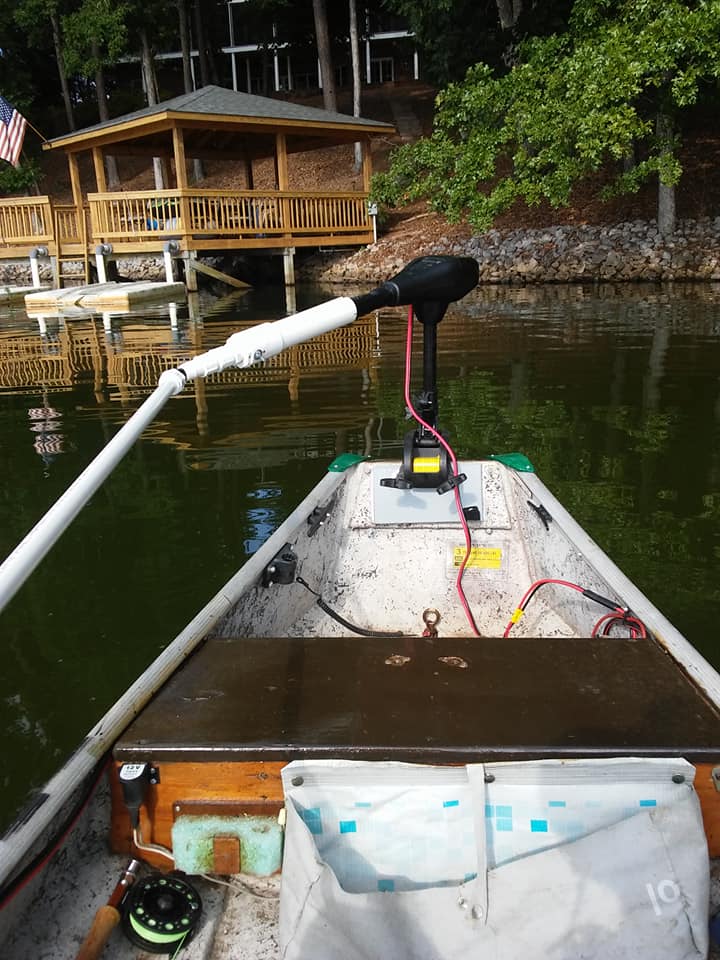
The solution is simple: a tiller extension with a pivoting, universal-joint.
Tiller extensions are another common feature on sailboats; they let you maintain direct control of the tiller and still allow movement around the cockpit.
And since I have to rotate the motors' tiller handle to control throttle, the extension must also include a U- joint.

The market provides just about anything you'd want for boats, and jointed extensions can be had for $50-$100... and that's yet another thing to put a kink in my already meager budget.
So I made my own extension.

Using a generic, industrial U-joint, a few carefully chosen PVC plumbing bits, and a little handywork...I was in business.
I'm pleased to say it works as intended; I can steer and control the throttle from the center position.
It works best sitting side-saddle, as is the case with all tiller controls.
The stark white color of the PVC will have to go, however. I'm thinking a camouflage scheme to match the boat....(UPDATE- this has been done. Camouflage...its now invisible LOL)


Swing it to the left... swing it to the right.

ODDS AND ENDS

Ready-holders for rods are a must on any fishing boat, and I managed to squeeze in a few to starboard. Most people festoon their small boats, kayaks, etc. with vertical rod holders - they look like porcupines.
But I can't fly cast with a forest of rods jutting skyward from my boat, so vertical rod holders are out of the question.

In the pic above, you'll see I've arranged horizontal stowage below the starboard gunwale.
For example, a fly rod is held at the ready under tension - the reel to the rear, a rounded "mushroom knob" for the middle, and the blue "fingers" forward to keep the rod tip secure.
The rod fingers are an idea I've used for years - any rod not in-hand has its tip section rested in the fingers so it doesn't wander around.
Down lower on the gunwale, you'll see three rod keepers to hold extra spinning rods, should I elect to carry them.
My usual rod load-out is:

1 Fly Rod
1-3 spinning/casting rods.


Seen above is a little tool bag forward of the seat, for a knife, pliers, etc.
The drink holder is now gone - its a good idea to have one, but THIS one was constantly snagging the fly line. 

I have a folding, streamlined model on the way to replace it.

THE READY BAG
This isn't directly related to the boat, itself, but it's key to smooth planning when going out IN the boat.
Something I hate is wasting time gathering stuff to bring fishing. I want everything prepped to go, so nothing is forgotten, and only the bare minimum effort is needed to get on the road.

So I depend on a "ready bag," which I keep by the door.
In it are essentials needed for being in the boat, but things which I don't want to LEAVE in the boat (fishing tackle is prepped and stowed separately).


Ready Bag


Ready Bag contents (L to R, clockwise)
Aqua shoes for use while in the boat
Dry, slip on shoes
Bamboo tube holding cigar
Matches
Knife
Signal Mirror
Signal whistle
Signal Horn
Sealed bag with cell phone, camera, snacks, incidentals

These contents are flexible and will come and go as the season progresses

BACKING-UP AIDS
I've never been good at backing trailers on a boat ramp - there I said it. 
Not ashamed, not sorry.
Knowing that I am potentially the worst at this crucial part of boating, I have been practicing a lot.
I just drive around town and find difficult places into which I can back the boat. This helps.

But one problem I encountered with The Toad Machine is that she disappears when backing down the ramp... I can't see her once she drops down towards the water!
And I can't open the tailgate because of the boats length, It must remain in the closed position.
To correct this, I added uprights and painted them bright, fluorescent orange.
Then, one day, I hit on an idea: I added markers on the tailgate itself that line up with each of the uprights.

Eureka!
This simple thing now offers me a visual aid as the trailer heads down the ramp.
Looks goofy, sure. Laugh if you wanna... I'm good with that.
But it helps me, and and that's what matters.


Headin' Out

Stick around, because there is more! Episode 2 awaits at the ling below:

Toad Machine Tales, Episode 2


I hope you enjoyed this and learned something from it. I get nothing from this other than the satisfaction of a job well done, so if you enjoyed it, a like and share is appreciated.
And if you are inclined, feel free to join our no-drama, no-hype Facebook group:

(click the  link)


Thanks for reading and Tight Lines,

David

Don't forget to subscribe and comment, and join us on Facebook here: Palmetto Fly N Fish
All rights reserved, ©2020


Monday, April 20, 2020

Optimum Temperatures for Fish

Freshwater Fish Optimum Temperatures
Water temperature plays an important part in the life cycle of fishes. 
As the water heats or cools with the seasons, fish behave differently and can be found in different places. Also, there are regional differences and acclimatization differences in the temperature ranges for various fish species.
However, each fish has a preferred temperature which suits it best.
With that, here is a general guideline to the optimum temperatures for most common fishes sought by anglers.


Species Optimum
American Shad 66
Atlantic Salmon 62
Atlantic Sturgeon 66
Black Crappie 70
Bluegills 70
Brook Trout 58
Brown Bullhead 74
Brown Trout                  56-66
Burbot 52
Carp 84
Pickerel 66
Channel Catfish                  82-89
Chinook Salmon 54
Chum Salmon 57
Coho Salmon 54
Flathead Catfish 85
Freshwater Drum 74
Grass Pickerel 78
Green Sunfish 87
Kamloops Trout                  47-55
Kokanee                  52-55
Lake Trout                  50-57
Landlocked Atlantic Salmon                  50-58
Largemouth Bass                  65-75
Longnose Gar 92
Muskellunge 63
Northern Pike 63
Pink Salmon 50
Pumpkinseed 81
Rainbow Trout 61
Rock Bass 70
Shortnose Gar 87
Smallmouth Bass                  65-68
Sockeye Salmon 55
Spotted Bass 75
Steelhead Trout                  48-52
Sunfish 58
Walleye 67
White Bass 70
White Crappie 61
White Perch 89
Yellow Bass 81
Yellow Perch 68