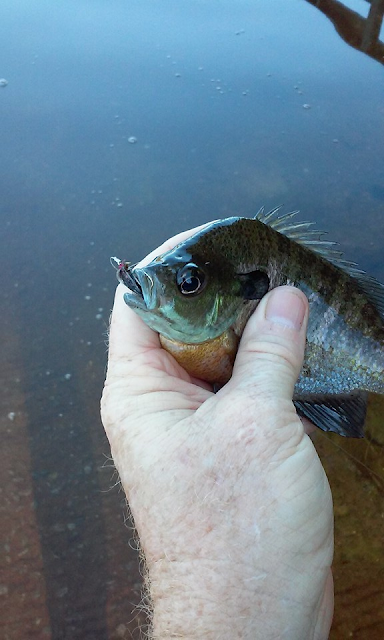
FEATURED POST

Edge of the Weeds

Monday, May 1, 2023

Favorite Flies, # 5: "The Sneaky Duck"

By David Hutton, Palmetto Fly n Fish

CHECKING All THE BOXES ...
"The Sneaky Duck"

    The Sneaky Duck shot onto my radar thanks to friend and fishin' pal, Donald "Don" Schmotzer. He found the pattern in the Spring 2011 issue of "FLY TYER" magazine, originally tied by Col. (Ret.) Roger Duckworth. 
    I don't know Colonel Duckworth, but if Don Schmotzer likes a fly and has success with it, you better take notice. You'll see why, as we hear more from Don further on.

But with a name like, 'Sneaky Duck,' a pattern has to do more than sound clever - it needs to check all the boxes.

------------<~~>------------
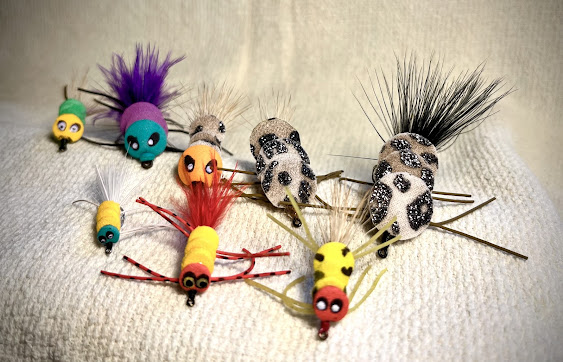


Assorted Sneaky Ducks

Materials and Tools
    The first thing you notice about 
the Sneaky Duck is the innovative use of common materials. The main component is 1-3mm EVA craft foam, cut into discs, then dressed with rubber legs and a few wisps of marabou and hackle feather. 
    The foam for this fly is just regular, "craft foam." It is inexpensive, it is found everywhere, and it is tough as nails. I really like the stuff.
    To make the discs for the Sneaky Duck, you
punch or cut 
them from foam sheet; you can crank them out by the dozens in no time. Hollow punches are the first choice for this work, but thin-walled metal tubing and cartridge cases also work well. If it is round, metal, and can be sharpened to cut foam, I have probably used it.


Don Schmotzer foto

Don Schmotzer foto

    You can also trace the circles onto foam sheet and cut them out with with curved scissors. It is tedious, but it works if you're just tying a few 'Ducks. I still do that now and then.
   
Colors
    One topic that always gets the proverbial feathers flying among anglers is color. Every angler has his pet favorites, and the trendy colors get more interest than honey in a beehive.
I'm not sure that fish share this fascination with the chromatic - one color seems to work about as well as the next. Nevertheless, w
hen it comes to colors for the Sneaky Duck, the sky is the limit.
    The original featured a chartreuse tail and body, black under hackle and white rubber legs. Don Schmotzer likes them that way, along with yellow and red. 
Glitter and sparkle foam are both nice, as well as all the common colors like green, yellow, white...and more! 

TIP: Don't neglect long wavelength colors, like blue or purple. I have found these to be surprisingly good. 


Purple and Blue w/ black legs

    Once you have your foam discs in your favored color, affix them in-line and overlapping one another, on top of the hook.
 A pinching cinch is needed to lock them in, and a dot of cement is added to strengthen the connection. Together, these discs form the floating body. 
    When combined with the other elements, you get a whimsical, "creature fly" that is not only visually fun, but it catches a lot fish.

    We are checking off several boxes, at this point!    

Don Schmotzer foto

Don Schmotzer foto


Don Schmotzer foto

Sizes
    My Sneaky Duck flies come in sizes 1-8 
for my target species, bass and bluegill.
- Sizes 1 thru 4 are about right for large- and small mouth bass. 
- Size 6 and 8 complete the Sneaky Duck panfish arsenal.
I'm sure you could go larger, if you were after pike, perhaps.
    
    So how about smaller Sneaky Ducks?
    L
et's have Don Schmotzer share his thoughts about "micro" Sneaky Ducks...

"I 
tie bigger Sneaky Ducks on #4' hooks. But my favorite for 'gills is #10's. I feel a miniature size 12 Sneaky Duck will also be a real '"gill killer.'"...  I intend to try a smaller disk (.30" or even .25") on a size 12 to see if I can find the right balance for a sunfish size Sneaky Duck. It may take a while to get the proportions right......but its fun to play with .......Don in SC

 
    I have tied them down to size 12, so that's doable if you like the lilliputian end of the scale. 
It is not all that difficult to do, although I leave the under-hackle off these teensy versions.


Size 12, 10, and 8!


One Extreme To The Other

    Lets now check off the box marked, "versatile," shall we?

Slider For The Win
    
I almost always fish top-water to start a session, and the Sneaky Duck is just right for that
. Fishing the 'Duck is pretty straightforward:

- Cast the fly to a fishy spot
- Allow it to sit and just "be there"
- Twitch it a couple times. Let it sit some more
    
    If nothing happens...

- Strip it hard, or snatch it with the rod tip. It will "duck" under the surface then pop back up.
- Be ready for the strike

    If you chose a spot with a fish nearby, it cannot help but nail that Sneaky Duck!

    Because of the sloping head and body, this fly is classified as a slider pattern. When you strip in the pattern, or twitch the rod tip, the fly 
dives, or "slides" beneath the surface. Then, when you stop, it floats back to the top.
    This action brings another element into the game: 
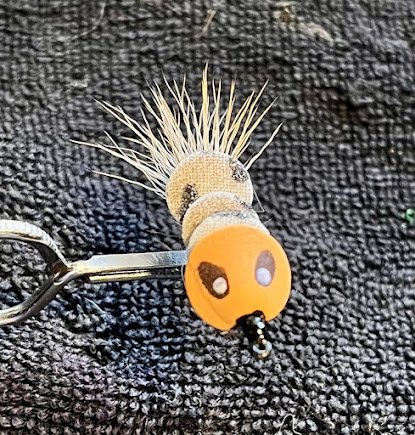
     
    Stealth….the Sneaky Duck is stealthy.

    This is a pattern that lives up to its name. It makes a noticeable disturbance that fish eagerly key on. But, it is a "quiet disturbance." 
    Unlike the splashy and noisome popper, sliders like the Sneaky Duck behave more like swimming or struggling prey. It is a subtle, stealthy presentation,... more natural. 
    It is, in short, a "sneaky duck," and that is yet ANOTHER box checked off!


No Legs, Deer Hair Tail

Sneaky Duck In Action
    I spun around quickly, fly rod held tightly in hand...
"Hey Don, quick - put it in neutral for a second!"
"Huh? Why?" he asked. "Hold on - you got a fish?!"
He shook his head in disbelief, shifted outta gear, and the boat slowed to a drift. 
"No, it didn't get hooked..., but I got a blow-up strike back there!"

    
We were creeping along the lee side of an island in Don's pontoon boat, with Don at the helm. He was keeping the boat at casting distance from shore, the prop barely engaged, and mostly just 
sightseeing. The two other guys in our party, Tony and Leon (RIP), they were on the forward deck, lazily casting flies to the shore and hooking up with small brim now and then. Everyone was in laid-back mode.

    Except me. I didn't come to lounge around; I had a different idea in mind.

    Standing on the rearmost platform of the boat, I remembered Buck Perry's motto, "Deep water is the home of the fish." From my stern position, I was focusing on that advice and surface-trolling a Sneaky Duck over subsurface weed beds.
    T
he other guys were fishing toward the shallow shore. But I was pulling a big, #2 Sneaky Duck behind the boat, over the deep edges of an underwater weed line, well out from shore...
     The water was clear and I could see the weed tops below as the boat passed over them. The 'Duck chugged along about 30 yards astern, when I spotted an inlet down in the weeds. I watched it fall behind the boat 'til it was just in range of my fly.
    As the 'Duck 'swam' into the open water above the cut, I quickly flicked a mend into the line and fed the fly some slack. In this way the fly twitched once, then just stalled and hung temptingly over the open spot - and POW! It got a big strike!
    That was what I was hoping for, of course, but no one took any notice until I spoke to Don. The others were pre-occupied with their own business, and Don was piloting the boat, so these events went unseen.
    "Hey guys," I exclaimed, "it looks like some pretty nice fish are holding on the outside edge of these weeds... we ought to move out a ways and work along there!"
    But my announcement fell on deaf ears. 
Tony was watching the shore, Leon had grown disinterested and was dozing in the sun, and Don was in his element guiding the boat. 
    Trolling a surface fly from the back of the boat? Well, lets just say you're not taken all that seriously for it. They looked at me and yawned. 
    My own motto is , 'Don't leave feeding fish," but by then everyone had had enough of this spot and decided it was time to go elsewhere. I looked at Don questioningly, he shrugged... and we veered off on a course for other waters.
    But the Sneaky Duck left a lasting impression at that moment. 

    Don has had his share of Sneaky Duck days, too....

"The other day at H - Ranch (private pond), I only caught a few of those wonderful copper-heads they have there...because I had to keep unhooking those pesky 'green trout,'... thirty-two times that day.

Its hard to get the copper-heads to bite when the bass chase them away from your Sneaky Duck! (I have had worse fishing days LOL)"
....
Don in SC

Don Schmotzer foto

Or...


"
I just got back from the lake; I was targeting bass with the Sneaky Duck. I lost two nice bass on a red & yellow one, but the big story was all the different sunfishes I was catching on the 'Duck. I couldn't keep them off of it! I have never seen so many in the shallow rocks this early in the year. 

My plan was to catch at least one nice bass to filet for supper, but I had a blast catching the brim anyway.
I caught about 25 sunfish and missed those two chunky bass. Not bad for 2 hours on the lake." 
....Don in SC

\
Green Sunfish
Don Schmotzer foto


Bluegill
Don Schmotzer foto


Lake-run Red Breast
Don Schmotzer foto


Summary
    Those who try the Sneaky Duck come to like it; good reports follow wherever it is cast. Meanwhile, the fly gets experienced anglers like Don Schmotzer into the action.
Little else is needed to recommend it.

    
    Proven many times over, the Sneaky Duck checks all the boxes...

☑ 
Inexpensive to tie - common, easily obtained materials
☑ Appealing to the eye - fun, whimsical, even "cute"
☑ Versatile - can be tied in many sizes, many colors
Stealthy - natural, quiet presentation
☑ Effective - consistently catches multiple species

    If we are honest, there are thousands of fly patterns that will catch fish. One of the greats in the fly fishing game had this to offer...

"The artificial fly pattern may be the most unique sporting element, or tool man has ever developed."

- Lefty Kreh

    With that in mind, lets check one more box for the Sneaky Duck...

Unique - ... it is a unique pattern, in a field that is itself, unique.

    Yes, the Sneaky Duck checks all the boxes. 

------------<~~>------------

Writers should strive for a job well done... even half-baked ones like me. If you found value in this article, please like, comment, and share it. 

Do you want to add any of the flies seen here to your own fly or tackle box?
Do you have ques
tions, compliments, or suggestions?
Email me at
...dahutist@gmail.com

If you appreciate a no-drama, no-hype Facebook group, follow this link and come join us at: 

Palmetto Fly n Fish

Thanks so much for reading, and...


Tight Lines,

Dave Hutton

© All rights reserved, David Hutton/Palmetto Fly N Fish 2023 

References

1. Donald Charles Schmotzer, aka, "Don" 

2. Fly Tyer Magazine, Spring 2011 

3. "Bluegill Fly Fishing and Flies," Terry and Roxanne Wilson
 
4. Ultralight Fly Fishing.com

https://ultralightflyfishing.com/forum/viewtopic.php?f=69&t=4686

https://ultralightflyfishing.com/forum/viewtopic.php?f=94&t=6196

https://ultralightflyfishing.com/forum/viewtopic.php?f=69&t=6167  

5. "Leftys Little Library of Fly Fishing," ©1993, Odysseus Editions
Sunday, April 16, 2023

Float Tubing and Tackle Talk

 July 17, 2016...UPDATED April 2023

I paid a visit to the lake this morning. Up with the sun, on the water by 8 am.

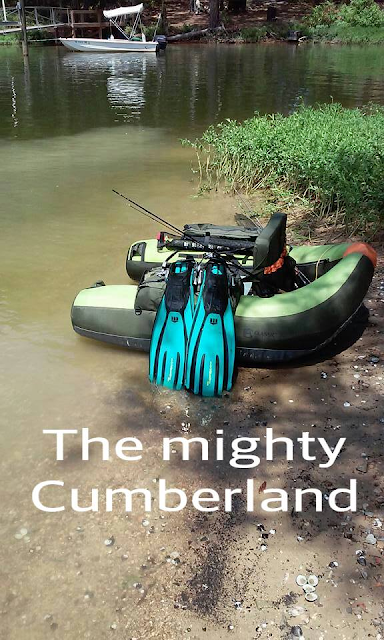
    I took the Cumberland float tube to an area I've fished from shore many times. It is a small point with a boat ramp, and a tiny cove along one side. It has a small picnic site fronting the cove, and in the back, the cove is filled with driftwood that has piled in from the main lake.


   I started with surface bugs, as usual. But top-water was the wrong game. The fish weren't having my surface flies, and only once did a floating fly get a serious strike - and that fish self-released.
    But I'm no one-trick pony; I'll switch up in a minute if I need to. And this morning I needed to.
    Time to go subsurface - and that is where the bluegill were biting.
    The best fly this July morning was a small Cap Spider I first saw in the fly box of pal, Don Schmotzer. As he ties the thing, it is just a bit of fine chenille or dubbing for a body, with rubber legs and a gold bead head. I think of these as "slow sinking spiders," but Don calls 'em Cap Spiders, and that's good enough for me.
    Other flies that shared the catching duties were,
- Flash bodied soft hackle
- Wooly Nymph
- Cockatoo.... this Ward Bean wet fly is a fave of mine (You can see my history with this fly, here: The Cockaroo A link to Wards site is in the references)
    Some of the fastest action came while trolling along the rocks seen in the pics below. That is a trusted tactic once the water warms. A number of fish also came right off the end of the boat ramp, itself. You have to watch out for boats and stay clear, of course, but the ramp has a sharp drop-off on the end that attracts fish.


Tackle Trials
    The No Knot Eyelet Experiment kicked off today, with the eyelet holding fast, through many fish and some hefty snags.       The immediate benefit to the No Knot Eyelet is that it puts an end to hanging in the guides, like you see with looped leader connections. The last time I saw that was with super glued leader connections.
    Detractors say that the No Knot Eyelet stresses the line and causes it to crack where the eyelet is inserted. Others complain that they rust and eventually break. Those things may in fact happen with neglect, but they seem like things one can get ahead of with awareness and line maintenance.     Under the magnifier, it shows no signs of failure.
The torture test continues.
    These tackle trials also extend to my new bargain fly line, from www.discountfishingDenver.com. That line was $12 in 2016 ... in 2023, it is $19.99. My rod is designated, "5/6 wt," and the line is a WF6F... a Weight Forward, 6 wt. Floating line.
    So what does that mean? On weight forward lines, the first 30 feet are supposed to be thicker and heavier than the rest of the line. It is designed to be forward oriented on one end.     The opposite occurs with double taper (DT) lines; they are slightly thicker in the center but thin out toward either end.     The rod says, "5/6," however, so that means it is designed to use EITHER a 5 wt. double taper (DT) level line, OR.... a 6 wt. forward weighted line.    This can be taken as a general guideline. It mostly depends on how much line you have out: - Shorter casts favor a heavier front section on the line.
- Long casts require a lot of line out, so you can load the rod well without the extra front weight taper.     Such a rod might also handle line a bit higher or lower, say 4 wt. or 7 wt....  Little is absolute in fly fishing, and each rod is different. In my case, this Weight Forward (WF) 6 wt. line is just right, and it makes the line effortless to cast. In a float tube, you can closely approach your target, and that little bit of extra weight does the trick on shorter casts..
    How about that bargain line.... what do I think of it?     Well, I'm a hack - not a line expert... I can't really give a hardcore line report. What I can say is it flows easily through the guides and is maybe smoother than my Scientific Angler lines. That may also be because it's new.
    But it lays nicely in the stripping apron, is quite supple and has no tendency to kink or twist. In short, the line was trouble free. I never had to worry about it, and I suppose that says something.
    On that subject, I've also started using Scientific Angler's pure silicone fly line dressing. I applied it to this line right away, before using it. It seems to have made little practical difference that I can tell over the bare line.     But I feel that using it gives an overall improvement in line performance and longevity, too. So I'll keep putting it on.     In fact, I put it on all sorts of things. My only regret is it comes in such a teensy bottle!


PS I get no sponsor kickbacks for mentioning this stuff. I just like it. If you know of something comparable, please let me know.


Random Pics


From L to R: Cockaroo, well chewed
Red Cap Spider
Flash Body Hackle Fly
Cork Popper

The Wooly Nymph mentioned in the narrative is not shown, and is a mystery to me, today - that was seven years ago, after all...
But the large popper was NOT the one to use on a late July morning.
Regardless, this inspires me to tie up some July Bluegill Kits!


Thanks for reading!


----------<~~>----------

Writers should always strive for a job well done... especially mediocre writers like me. So if you found value in this article, please like, comment, and share it. 

Do you want to add the catching flies seen here to your own fly or tackle box? Do you have questions, gripes, or suggestions?
If so, email me at
...dahutist@gmail.com

If you appreciate a no-drama, no-hype Facebook group, follow this link and come join us at: 

Palmetto Fly n Fish

Thanks so much for reading, and...


Tight Lines,

Dave Hutton

© All rights reserved, David Hutton/Palmetto Fly N Fish 2023 

References
1. http://www.warmwaterflytyer.com
2. https://www.facebook.com/groups/flyfishingsouthcarolina
3. https://www.discountfishingdenver.com


Saturday, April 15, 2023

The Cockaroo


    I'm very fortunate to be admin for the best Facebook fishing group going, ""Palmetto Fly N Fish..., and still going strong after 8 years. This is one my most gratifying achievements, and in the world of social media user groups, eight years just may be a record!

    A blessing that comes with such longevity is that a lot of archived content accumulates across the years.

    Our group has the best members from around the world, and they add content. Much of the content is added by me, something I love to do. The Blogger page you are reading now is also under the PFnF umbrella - with its own content.
    Taken together,... well, 8 years of content is a lot! 

    Due to recent health issues in the family, my outdoor fishing adventures are curtailed for the foreseeable future, and new content from that direction is on hold.
But, with 8 years of collected content at my fingertips, I have plenty in the "database" to fall back on.
    Whenever a topic comes up, I just go through the old posts and see what turns up. 90% of the time, I find something useful, and 
today's featured fly is no exception. A number of posts were there and waiting, about Ward Bean's, "Cockaroo." 

- All photos and flies by the author, except where noted 

----------<~~>----------


Cockaroos, flat wing, and tented


In the Creators Words
    Ward Bean may not be a household name, but in the world of warm-water fly tying and fishing, he is a big deal. This is largely thanks to his wonderful site, "Warm Water Fly Tyer." 
    I consider it a staple among internet fly fishing sites, and if you want to take part in this activity, you must check it out. Among the many useful patterns found there, Ward includes our subject, "The Cockaroo."

    He says this about the pattern... 


"The Cockaroo wet fly, so named because it's tail and wing come from a rooster Ringneck Pheasant, is one of my favorite panfish flies. Bluegills, especially love to eat this chubby little critter."


Cockaroo by Ward Bean
http://www.warmwaterflytyer.com/patterns4.asp?page=3

    I couldn't have said it better myself - the Cockaroo is one of the best sub-surface patterns I have used!     And I'm not the only one to say that. Bart Lombardo, the driving force behind another must-see site, "Panfish On The Fly," he offers this:
"During a recent exchange with a gentleman by the name of David Hutton on Facebook, I was reacquainted with this particular fly.         David posted a picture of a 'Cockaroo' that he had tied and was fishing. There was immediately something familiar about the pattern - I had seen it before. David quickly pointed me to his source for the fly pattern, and all the pieces fell into place....     To address those that say panfish will take any fly, I did a side by side test with my usual early season wet flies. Both versions of the Cockaroo took far more fish than the other wet flies, when fished together on a tandem rig.
    A scientific study? No, but enough for me to add this pattern to my early season arsenal as well as my regular wet fly box!"     That's ample recommendation in my book, and Bart even called me a "gentleman."     Considering the rarity of THAT..., I'll take it.

The Cockaroo For Bart 

In My Own Experience     Lets look back at a few of the Palmetto Fly n Fish archive posts where I featured the Cockaroo to glean some more gems about it:

-> "The trusty Cockaroo was cast way back into the head of a pocket, maybe a foot of water was there. The fly hit the surface, sank, and was swarmed the instant I moved it. The bluegill was feisty, hand-sized, with vibrant colors. I got the pic at the waters edge, before working out the hook. Once freed, it went back quickly, unscathed."


-> "Donald Charles Schmotzer (one of the best fishing buddies anyone could have) will remember this is the fly that took a grass-bed bass early in the season. It was a surprise to him, as he was sure floating spiders were the way to go."

-> "It was raining and cool over the last week, but a little break was all I needed... and I hooked a substantial bass straightaway on a #8 Cockaroo.
    This is a routine I see repeated often: Bass taking lilliputian, insect-like flies, those intended more for bluegill or trout.
    Of even greater interest, is that the take is subtle. If on a surface fly, it is just an uncertain disturbance where your fly USED TO BE ... if it is a sub-surface fly, like the excellent Cockaroo, your line just stops and you think you've snagged a bit of weed."
-> "I took off early for a little shore stumbling around the Riverbend. I spent 60% of my time roll casting from overhanging banks; my timing was a little off at first, but no tangles or break-offs occurred!
The flies that caught fish:
Red Head Cockaroo - subsurface
Moodah Poodah - topwater"


Cockaroo Variations, at Random     


Here's a fairly rough version of the, "Cockaroo." Alright, a legitimately rough version. Okay.... Let's be honest; a bad copy of his version.


"Back Shank Cockaroo," the fly tied to the rear of the hook shank to discourage deep hooking


Redhead Cockaroo

    There you have it, "The Cockaroo" - a most excellent fly that YOU, too, should have!
    
    See what I mean about looking at things that came before? It can be time well spent!


----------<~~>----------

Writers should always strive for a job well done... even mediocre ones like me. So if you found value in this article, please like, comment, and share it. 

Would like to add the catching pattern seen here to your own fly or tackle box? Got questions, gripes, or suggestions?
If so, email me at
...dahutist@gmail.com

If you appreciate a no-drama, no-hype Facebook group, follow this link and come join us at: 

Palmetto Fly n Fish

Thanks so much for reading, and...


Tight Lines,

Dave Hutton

© All rights reserved, David Hutton/Palmetto Fly N Fish 2023 


References
1. http://www.warmwaterflytyer.com/patterns4.asp?page=3
2. https://www.facebook.com/groups/flyfishingsouthcarolina
3. https://www.panfishonthefly.com


Tuesday, April 11, 2023

PHANTOM WOOLY WORM

EARLY SEASON TROUT AND THE PHANTOM WOOLY WORM

Unlike men, who are inclined to go out too early in the year and freeze their butts off, trout know how to find comfort in the high, cold water of the early season:

- They stick close to the bottom, away from the heavy current. 

- They congregate in backwater eddies where they don't have to exert themselves.

-  Trout aren't inclined to move much out of their way to take a fly in opening day water.

To be successful, the fisherman needs to know where the preferred eddies are, they must use a fly that is visible to trout in murky water, and they should fish it slow and deep. 

Building a little weight into the fly helps it sink properly, and permits easier casting than weighting the leader above the fly. 

A sinking line may help, but only where enough line can be extended to pull the fly deep. However, on small streams, where little more than the leader is cast, the sinking line has a minimal effect on the fly's depth.

One of our early season favorites is a wet fly we call, “The Phantom Wooly Worm,” a variation of the popular western pattern. 


The fly utilizes a palmered badger hackle, the black center of which blends with the black chenille or wool body, making the white tips of the hackle fibers appear to be detached from the fly. 

This creates a “ghost-like'' halo effect in the water, inspiring the fly's name. 

The fly shows up well in off-color water and the trout are fond of it.

The Phantom Wooly is a fly even beginners can tie easily. Try a few for your fly box.

TIPS - 

- 3 or 4 peacock sword fibers for the tail, with a tiny false tail of red wool tied over the top as a tag.

- A piece of lead wire is tied lengthwise along the shank

- Prior to tying in, stroke the badger hackle fibers backward on the feather shaft, so they stand 90 degrees from the stem.

In the foto, you can see the result!

- Hook sizes #6-14

- Note in the foto caption, Mr. Lively also recommends this fly as one the BASS love

CHAUNCY K. LIVELY,  APRIL 1965 PA Angler 

Updated Jan 2020

Monday, April 10, 2023

Bass and Panfish Top To Bottom - Make a List!

David Hutton
October 8, 2018

----------<~~>----------

As an angler, you put a lot of effort into your pastime. Just getting ready to go fishing means gathering gear, arranging travel and schedules, maybe preparing food or drink... and that's before you leave the house!
    This means it is important that you also spend some time listing what worked, what didn't, and what might be improved for the future.
    Most of those that take this advice will have long lists of what went wrong. For most of us, this kind of "failure analysis" tends to be our go-to... it is cultural to do it this way.

    And after all, who doesn't like lists?

     But we can probably do more to aid our future success if we organize our lists around what has worked, and build from there. 
        So from time to time, I root around in my fly wallets, the articles I've written, and the many tying room boxes to make a list of flies that work as hard as I do....


Where They Work    
    The water I fish most often is Lake Murray, S.C. 
    It covers about 50,000 acres, 600 miles of shoreline and is home to three distinct biotope zones.
 It is 12 minutes from home, and it has everything from large stripers to the teeniest minnow. With all this going on, my flies have to make the cut to be considered keepers.
    I mainly focus on largemouth bass and the numerous panfish species found in the lake. Striper burst in now and then to mess with the real fishing; they are the rowdy teenagers of my fishing word. But I have only passing interest in them.
    My kind of fishing is more laid back, more artful... that is what I tell myself, at least. And it centers around a one-two punch
 to the fish...

Step 1. Top water, first
Step 2. Sub-surface, second. 

    This is cerebral fishing, where one works the entire water column - top to bottom. It follows the process laid down by Bill Byrd, Georgia's ultralight fly-fishing master. It is methodical, warm-water panfishing, and that suits me.*

Top Water
    This "system" normally starts with fishing surface flies. That's easy enough, right?
    The truth is, fly fishing is primarily a surface oriented activity, anyway. We love the surface bite, floating lines are the most popular, and who doesn't drool over the latest bugs and poppers?
    To go well below the surface with flies requires tackle change ups, an increased mental focus, and a certain "instinct," or "feel" that takes time and effort to develop.
    What a pain!
    So a great many fly anglers just stick to the surface, and near-surface water for their fly fishing action.
 
Sub-surface
    But we have a conundrum with all this top water business:

The fish we most often seek don't live at the surface -
they just visit there
    
    The bad news is that the top-water bite only accounts for maybe 10% of the fish's feeding; 90% of the time, they live and feed below the surface.
  Knowing this, one might wonder why we shouldn't just go straight to the subsurface fly.... and sometimes that's exactly what I do. 
    But unless there is some obvious reason to do that, I begin every session with Step 1,... top water flies and presentations.
    If that is working, I stay with it, because it is awesome!
But when it stops working, well....   
 
    Unfortunately, you will find times when you can't buy a bite on the surface. You get a lot of casting practice, but not so much catching. 


repeat...repeat

    Eventually, frustration grabs you, and you mutter aloud, "Where did they go?! They were just here!" Some yelling, cussing and hair tearing may accompany this outburst. You might even start calling softly,... "Here fishy, fishy, fishy!"
    Hey, don't act like you've never done it.

    But you already know the answer to your question...where they went is below somewhere, and you have to switch up flies and tactics to find them
.

    Because fly fishing folk hit this wall often, the top question they have is almost always, "What flies?"
They are interested in rods, and reels, and which logo is on your hat, too. But the business end of the thing is usually uppermost in their mind. 
    Having dug through my written musings, all my dusty fly boxes and crates, I am now prepared to list some of the s
urface and subsurface patterns I have used with good effect.
It is not a long list - but it IS a list.

    And who doesn't like lists, after all?

Bass and Panfish Flies, Top To Bottom

  • SURFACE PATTERNS

Foam Spiders and terrestrial bugs: gurglers, beetles, Taylor Bluegill Spider ....

The Fliedermouse:  Harrison Steeves foam-and-deer hair creature pattern ....

The Sneaky Duck: a stacked foam disc, floating-diving pattern
Our good friend, Don Schmotzer, discusses this one:

Poppers - styrofoam, stacked craft foam, Flip Flop Popper

Dry Flies - standard trout dry flies, tied large and small. This is an often overlooked group. 


  • SUBSURFACE PATTERNS

"Murray Hackle Fly"... Murray Hackle Fly

"The Briminator" ... The Briminator

Bart Lombardo's, "Creature" .... The Creature

"The Cockaroo" - Ward Bean sub-surface pattern using pheasant feathers... The Cockaroo

Nymphs - 3-Way Nymphs, "Faux Fur Casual Dress" ....


- Honorable Mentions

"Dixie Finn" - color variation of the classic Mickey Finn, with Chartreuse/White, Chartreuse/black, Chartreuse/brown
"Because in the South, if it aint chartreuse - it aint no use."

"Woolly Buggers" - for bass and panfish, grey/brown, sizes 2-6

"Soft hackles" - sparse body and hackle - good for near-surface panfish

"SMP" Skip Morris Panfish fly - a Crazy Charlie tied with marabou.

Flies For The Future
    We could probably all do better behind the fishing rod if we focused more on consistently finding fish, rather than keying on flies. But anglers don't think that way - we never stop seeking the next magical, fish catching pattern.
    And I'm no different... t
here is always a new pattern I want to try. In fact, I can name three of them:
  
- Gary La Fontaines, "Airhead"... a simple surface pattern of dubbing, deer hair, and closed cell packing foam


- Bob Clouser's, "Swimming Nymph" - I view nymphs as the single best pattern type for my style of fishing. This one looks like a dandy.


- Mini Minnie - This streamer-like pattern from Terry and Roxanne Wilson uses a weighted dubbing material for the body


    There you have it - a short list of flies that have worked for my warm water fly fishing.
Are there others? Of course - I simply cant show them all in a single blog post.
Can some of these cross over into other waters, for other species? Yes - fish pretty much eat the same things wherever they live... only the details change a little.
    But I promised you a list, and, well, who doesn't love a good list?


NOTE: Sadly, Bill Byrd passed away in 2021. With no one to keep paying the bill, his internet site has fallen into the Dead Domain Zone.
While he was still alive, Bill gave me direct permission to use his articles and writings, and I make sure his memory lives on...
you can read my tribute to him, and access an archived version of his writings here: Bill Byrd Tribute 
If you find value in Bills archived writing, I urge you to copy and file what you like. It may not exist forever.

----------<~~>----------

Writers should always strive for a job well done... even mediocre ones like me. So if you found value in this article, please like, comment, and share it. 

Would like to add any of the catching flies seen here to your own fly or tackle box? Got questions, gripes, or suggestions?
If so, email me at
...dahutist@gmail.com

If you appreciate a no-drama, no-hype Facebook group, follow this link and come join us at:  
Palmetto Fly n Fish

Thanks so much for reading, and...


Tight Lines,

Dave Hutton

© All rights reserved, David Hutton/Palmetto Fly N Fish 2023 

References
- https://palmettoflynfish.blogspot.com/
- https://thebluegillpond.com/product/mini-minnie/
- www. pinterest.com
http://www.tomsutcliffe.co.za/fly-fishing/fly-tying/item/219-la-fontaines-air-head.html