FEATURED POST

Edge of the Weeds

Saturday, April 2, 2022

Simple Flies Catch Fish

    "Keep It Simple, Stupid."

----------<~~>----------
   Words to live by, right?     Otherwise known as, "The
The K.I.S.S. Principle," you have probably said these words yourself. Most likely, you have also heard it in any number of ways...
"Don't overthink it...", "Stick to the basics..." "Less Is More..."     The focus of this scatological directive is to keep you from going down a rabbit hole of complex solutions,... and causing more problems. 
    Just keep it simple, in other words.
    But, there is a warning handed down to us from no less than Albert Einstein, a complex man if ever there was one. He admonished us not to make things too simple...
"Everything should be made as simple 
as possible, but not simpler."

- Albert Einstein
      What can we take from all this? Well, a couple of things come to mind:
1. I'm not going to argue with Einstein on the matter 2. We should keep things as simple as needed, but not simpler.
    Which leads us to the question of the day: "Just how simple can you go in fly tying?” Do Simple Flies Exist?     How many times have you marveled at the many gorgeous, artsy fly creations we see? Their flights of fancy stimulate our sense of wonder and imagination.     And how about, the crazy, almost circus-like salmon, or bass flies of old?
    In still another group, we find spun deer hair "bugs and beasties." These over-the-top contrivances are becoming more and more popular.     In all of these, there is craftsmanship, artisan effort, and workmanlike devotion. And all of them try to outdo the others to see just how many different materials can be lashed to a hook. Simple is not what you would call these flies.     So if that is one extreme, what IS a, "simple fly?"
* * * * * * * * * * * * * * * * * * * * * *

Simple Is As Simple Does
    I asked this question once, somewhere around 2012, and in answer, I tied a single hackle on a hook. It was just some cement on the shaft, and a hackle palmered on.
    No kidding, that was it. Nothing else.     I wound on all the hackle the feather had to give, so we can say it was full and well hackled. But, hook and hackle were all I used - it couldn't be simpler.     And I'm pleased to say that the outcome was better than this humble arrangement might suggest. Not only did it catch many fish in the nearby pond, but the fish hit it with authority. I mean, they nailed it!
    That was about 10 years ago, but a similar fly caught fish just yesterday. So it wasn't a fluke, or some trick of my memory.     Bottom line: Simple flies catch fish.
Simple Is Heartless
    Okay, there it is - "Simple flies catch fish." I am happy at this revelation, of course, and I could just leave it there. But I am also a little disappointed.
    Why disappointed? Because I have books - lots and lots of FLY TYING books.     My shelves groan under their weight; some of you reading this have probably written a few of them! Each time I get another one, my wife clicks her tongue as only wives can, then exclaims, "ANOTHER fly tying book?!"     And those books..., oh, those glorious books... why, they are just FULL of fly patterns. I mean CHOCK FULL!
    More than that, each pattern is guaranteed to make the fish sit up and take notice. If you were to advertise Superman and his powers, you could hardly compete with the puffery heaped upon every fly pattern we encounter. Reading their narratives, it's hard to imagine you have lived this long without them.          Materials for the things range from the commonplace to the exotic, each fly has its own exacting type of hook, and the patterns are coupled with clever, sometimes arcane techniques for crafting them.
    Besides all that, I have invested an imposing sum of money in these written works; I cannot ignore them for simple, mundane flies, can I?     Of course not; I am committed. I am obligated to tie everything but simple flies, and to like it, by God.

* * * * * * * * * * * * * * * * * * * * * * *
    Let us leave the world of books for a moment, and return to my simple fly from 2012.     There I stand at the waters edge, line in hand.     On my leader is that single, half-chewed feather on a 2 cent     hook... and I release yet another fish caught on that oh-so simple thing.     That's when it hit me like a brick - "You mean, I only need something THAT simple to catch fish!?"     The nearby egret hears me muttering to myself, and squawks his affirmation... "Ack! Yess!"
    That revelation put a permanent wrinkle in the fabric of my fly tying. The egret only made it worse.     
We Know More Than Fish     Certainly, I love all my books; because of them, I KNOW stuff.     But, ... well, ... fish don't read books.     They don't to know they are supposed to go crazy for all the things the books tell us to tie onto hooks.
    This leaves me with an inescapable conclusion:     They go for simple flies because there isn't anything lurid about them. They like them precisely because they are simple.
A Few Flies from History
    To further look into this idea of simple, join me as we turn back the hands of time... back....back...


Step Into The Wayback Machine

    Going to the olden days, and I mean centuries ago, we find the old flies were also quite simple. The people back then didn't have the cornucopia of natural and synthetic materials we enjoy.
    They had a handful of feather types, wool or other animal hair, and some relatively
rough thread. With these common ingredients, they crudely whipped their flies onto rustic hooks - and they caught fish.
    For example, there is the most well-known of the old flies, the Macedonian fly Claudius Aelianus famously described in his "Varia Historia."     This was a sort of an atlas if you like, and the following was written around the year 200 A.D.

"....When a fish observes a fly on the surface, it swims quietly up and gulps it down.
Now, although the fishermen know of this, they do not use these (live) flies as bait; for if a man's hand touch them, they lose their natural colour, their wings wither, and they become unfit food for the fish.
But the fishermen get the better of the fish, nonetheless, by their fishermen's craft.
They fasten red wool 'round a hook, and fix onto the wool two feathers which grow under a cock's wattles, and which in colour are like wax*.
Their rod is six feet long, and their horse hair line is the same length.
They throw their snare, and the fish, attracted and maddened by the colour, comes straight at it." 
    This is from 1800 years ago. Red wool on a hook, with a couple of medium ginger feathers from a roosters' neck. There we are again - SIMPLE catches fish!
Fish Are Not Pushovers     At this point we must address the idea that the fish of old were stupid enough to fall for these simple flies. Today, we complain loudly about "educated fish" - they are wise, crafty, intelligent, and so on.... and that's our excuse for not always catching them.     We are certain that in the "old days," fish were clueless push-overs.     On the contrary, the waters of these early times were not isolated in the back woods. Those waters of which earlier men wrote were well-traveled, and overrun by meat-hungry people who wanted to eat fish.     Any finny denizen of these waters was locked in a daily struggle to survive against both its natural predators, and a horde of two-legged ones, as well.     History is full of writings, pictographs, and lore that clearly show mankind was keenly after anything that lived in the waters of the planet. They were unrelenting, too; wherever they could reach, they were trying to take fish.
Alta Cave Art, Norway
Egyptian Fly Fishing?

Greek Rod and Line Angling

Medieval Fishing with Nets

Medieval Fishing with Rod

    Going by these pictures, its pretty clear that no fish has ever been safe from hungry humanity, wherever they may swim. And where flies of some sort WERE being used, they were, by default, simple flies doing the job needed.     So the idea that simple flies only take stupid fish... well, it doesn't hold water.
Modern Day Simplicity     Remember all those books of mine? Among them is one in particular that fits into the theme of simple. That book is by C. Boyd Pfeiffer, and looks like this...


    Catch that title: "Simple Flies...Flies you can tie with three materials or less." Even better, the materials in the book are also simple: fur, poly fibers, a few feathers, maybe some craft foam.

    Mr. Pfeiffer authored 24 books, countless articles, and is an Outdoor Writers Guild Hall of Fame member.... he knows that simple works.     How about Bob Clouser, and his famous, "Deep Minnow," more popularly called, "The Clouser Minnow."     Bob has a number of patterns to his credit. But, his most famous one - The Clouser Minnow - is just a few tufts of bucktail and a pair of dumbbell eyes on a hook. He's another guy who knows simple

    And lets not omit the "Wooly Bugger" Even the most rank beginner to the fly fishing arts knows that one...every discussion of Top 10 Flies includes it. It's often suggested that more fish have been caught on the Wooly Bugger than any other fly. But it is nothing more than marabou, chenille and a frilly hackle fiber wound up the hook shank. Super simple, people.     One of my favorite simple flies certainly qualifies here. Sometimes called a "flymph" by the trouting crowd, or by the generic, "soft hackle nymph," I started calling them, "3 Way Flies" before I knew these other names.     I tie them in every size from 12-4, and they have caught more fish than I care to count.

    The 3 Way Fly is nothing more than... 1. A tail of some kind, plus... 2. A body of some kind, plus... 3. A hackled shoulder collar of some kind     There are no exacting instructions, no complicated techniques, no demanding materials. Just 3 basic elements to create a simple, fish catching, 3 Way Fly! Can It Be Simpler?     So how simple can a fly be, allowing for the hook and thread? One material? Two items of material? Three materials?     Well... yes.     By now you'll probably agree this is the bottom end of simplicity - somewhere between 1 and 3 materials. Of course you can pile on as much as you can cram on a hook, and we fly tyers will drool over it. It's kinda what we do.     But do we need to, in order to catch fish?     It would seem the answer is no.     And once I figured that out, a positive emerged: I don't buy near as many fly tying books as I used to! Thanks for reading, and "Tight Lines!"

----------<~~>----------

I hope you liked this article, and learned something from it. 

I go for a job well done..., since I have no idea how to make money at it. 😁 If you think I did a good job, please like, comment, and share. 

David Hutton
Palmetto Fly N Fish 

If you have questions, contact me at: dahutist@gmail.com

If you would like to join a no drama, no hype Facebook group, follow this link: 
Palmetto Fly N Fish

All rights reserved, David  Hutton© 2022/2023 

References 1. Http://seventeenthcenturyflies.blogspot.com/2010/03/flies-of-charles-cotton-1676.html

2. https://rivertoprambles.wordpress.com/2014/02/18/variations-on-a-first-trout-fly-pattern/ 3. "Simple Flies... Flies You Can Tie With 3 Materials Or Less", C. Boyd Pfeiffer
4. "Peabody's Improbable History," Jay Ward Productions
5. https://midcurrent.com/history/aelian-lives/


Sunday, March 13, 2022

GO FOR BLUEGILL!

BLUEGILL!

That word strikes a fondness, and the urge to fish, in many an anglers heart.
After all, is there anyone that can't have fun catching colorful, willing bluegill?


Bluegill, lepomis macrochirus, is a distinct species among a rather large group we have come to call, "sunfishes." 
It has many cousins in this family, known as, 'Centrarchidae' - the largemouth bass, for example, is in the sunfish clan,... a curious factoid that delights many freshwater anglers.

And as much fun as that is, here is where the path wanders a little, because bluegill are also generally lumped into an even wider group known as, "panfish."
This term, 'panfish,' is heavily used to describe any number of smaller fishes, from perch to trout, and is mostly applied to edible game fish that will fit into a frying pan.

But for the purposes of this piece, if I say "panfish," what I mean is bluegill.
Or "brim," as we call them where I live in the South. Some people call them "bream," too..., and we Southerners just look at them and assume they aren't from around here.


The Prince
Anyway, ...the bluegill. It gets a place all its own, in my esteem.
It can rightly be called the, "Prince of the Panfishes."
It is one of the most satisfying fish you can catch, and probably the first fish on which most anglers cut their teeth, at least in the United States.
And for some of us, they retain their princely status throughout our lives.

In fact, some anglers - like me - focus on bluegill as their primary quarry...


                                      My Custom Decal

While it is true that bluegill can be caught on many things, from live bait, like worms and crickets, to whirling metallic lures,... I prefer to fly fish for them, although that isn’t the sole focus of this article.

No, what we want to do is have a look at my personal best reasons to GO FOR BLUEGILL!


Bluegill Are Nostalgia
Here in the United States, the natural range of the bluegill runs from The Great Lakes to the Gulf, from the Atlantic to New Mexico. But these scrappers don't stop there. Bluegill have been introduced to every state in the Union, except Alaska. (1)

With such a wide range, a great many folks have access to bluegill, and indeed, it was the first fish for legions of kids. Thus, the figure of a small boy with a cane pole, and a stringer of "sunnies," is a potent image that strikes a chord for many....because it relates to their own lives.

Oddly, though - not me. My first fish was a trout, at about age 5.
Me...I was five. I don't know how old the trout was.

We probably had bluegill around our part of California, back then, but we didn't fish for them. During my childhood, the only fresh water fish I had any experience with were trout and minnows.

By the time I grew and had a family of my own, I still wasn't keyed in on bluegill.
I knew them from living in Florida for many years, but didn't pay them any mind.
Then, in the mid-1990's, my stepdad took me to a spot on our local lake where we caught bluegill like I had never seen before. 

These were not the small hand-sized fish I was used to. 

They were huge, helmet-headed things, nearly black in color and kind of intimidating, to be honest... In the South they call these, “titty brim,” because they’re so big and powerful, you need two hands to hold one securely against your chest!

I remember all the details of that experience, still.
It opened my eyes to another, hidden world of the bluegill, different from the one most anglers content themselves with.
That is where my PERSONAL, “bluegill nostalgia" begins.

This changed everything. While most anglers feel the call to graduate beyond a can of worms and the humble bluegill, I never have. I now know there are bluegill out there that few will ever see, and I make it my challenge to find them.
For me, the Prince of Panfish holds a special and unique place in my memory.
And it lies there, waiting, never really disappearing.

So, for me and others, the bluegill has nostalgia attached to it.


Bluegill Are Ubiquitous
One of my favorite words, "ubiquitous." 

The dictionary defines it this way: 

ubiquitous

yoo͞-bĭk′wĭ-təs

adjective
"Being or seeming to be everywhere at the same time; omnipresent."


That first trout that I caught, mentioned above, well, it required my parents to forge an expedition to reach the waters where it lived. It was not ubiquitous

Bluegill would probably have been much closer.

Now, consider again the range of the bluegill.
They literally are everywhere. Ubiquitous!
Bart Lombardo of, "Panfish on the Fly" says something to the effect that these fish are his, "...neighbors - they live right down the road."

If you want to catch barramundi, well, you'll have to head to Australia.
Mountain trout, when you live along the coast?
Another far reaching trip is needed.

But bluegill?
There's probably a city park or some such place you can bicycle to, and catch bluegill. Maybe you cross small streams, pass by ponds and lakes, or skirt well-filled drainage control ditches as you go about your daily routine. I know I do - and I have tested a good many of them and found that they hold bluegill.

That is ubiquitous. Yep, I love that word.


Bluegill Are Value
You've probably noticed the cost of everything today is rising precipitously, with little sign of coming down. We hope it will, but we're not sure....
Meanwhile, anglers go right on chasing whatever "trophy" they desire.
But, the reality is that getting to the "hot" locations, going for the big whoppers, having expensive tackle, taking grand safaris... all these things are a stretch expenditure. A hit to the wallet, in other words.

Possessing all these things, and traipsing all over for some fishing, well..., that may be increasingly out of reach for many, in the near future.

That's when I remember something I read, to the effect that I can recover the cost of my fishing license on almost any bluegill trip. (2)
Here's what I mean.

My South Carolina freshwater license is $10 per year.
And now that I'm officially an old geezer, the state even gives me a discount on THAT meager sum. (3)
With most white-fleshed fish selling between 5 and 10 bucks a pound, it doesn't take too many fish to recoup that license cost.

And even if I don't care to keep fish for the table, bluegill fishing doesn't require exotic tackle or expensive gear.
The fly fishing bro's are out there with $300 reels, $100 shirts, fly lines that require a small loan... and that's fine if they want that.
Me, I have a quality used fly fishing outfit.
I tie my own flies and leaders, and have a few simple pieces of needed gear.
The total cost of my bluegill set-up, the whole shootin' works?
Maybe $100.
Maybe.

And its good for years and years to come.
I dunno about you, but that's value in my book.


Bluegill Got Game
Bluegill aren’t just valuable as catch-and-keep eating fish. They also provide an amazing amount of sport in a small package, putting up a hell of a fight for their size... whether you eat them or not.

I’ve gotten into fish that I thought were bass, only to find a decent bluegill was on my line. They wont go airborne like bass, but they will turn that broad, disc-shaped body to the side and pull you into a fine scrap.
That throbbing battle is made all the more exciting on light fly tackle in the 3-5 wt range, and may be one of the best fights you'll find in any body of water.

Its been said that they if they weighed five pounds - most of us would not have the skill to land one!

Along with this is the fact that they are shoal fish, so they are in competition with one another. When they are feeding, they attack, or attempt to attack, anything that resembles food. Most of you reading this have probably caught small bluegill on large lures, and marveled at their feistiness. Its a tough world in which they live, and they don't dilly-dally. They hit hard!

The last part of this, "bluegill game," is to understand that they also school by age/size, and to focus your efforts on the larger fish. Do THAT, and you may find your rod nearly taken from your hand at times.

These bigger fish, the bull and hen bluegills, they are not the juveniles found in the shallow, "shore necklace." These guys live in deeper water, and have a different existence.
They are not eager bait stealers, but demand that you first find them, then present the RIGHT THING, THE RIGHT WAY, at the RIGHT TIME. If you can figure all THAT out, well... we all want to fish for a quarry that is eager, even bellicose, and which surprises us with its ferocity. Right?
If you can scale back your thinking, and your tackle, to accommodate the larger bluegill specimens, you are gonna get schooled in a new kind of respect.

SIDE NOTE: Fishing for bluegill also opens the door to numerous by-catch species. Bass, perch, redbreast and red-ear sunfish, pickerel, crappie, catfish, even carp and gar are all possibilities... and I've caught them all but carp while bluegill fishing.
"Oh, you're just bluegill fishing..." people will say to me, with a touch of scorn in their voice.
"Yeah, that's it." I say with a wink. "Just bluegill."


Bluegill At The Table
Speaking of respect, you catch-and-release anglers might not care about eating bluegill - but much of the country grew up with these delicious fish.
To those folks, this matters a lot.
As panfish, they go best inside a frying pan. And while I generally release most of my fish, I count bluegill as one of the tastiest fish I might eat.
It has a firm white meat that is both palatable, and mild.

Since they are essentially flat, they produce thin, flaky fillets if you have a talent for that kind of work. But cooked whole, too, they are delicious as a finger food, taken right off the bone.
Fresh hush puppies and cole slaw, to accompany, of course.


Bluegill Have Generous Allowances - Sorta
In Nature's scheme of things, the bluegill is prey for bass, trout, and other large game fish. So she ensures that they are prolific, and breed in high numbers.

This abundance normally means possession allowances* for bluegill are generous.
Most states offer bluegill catch allowances in multiples of ten.
In my state, South Carolina, for example, it is 30 per day.
In some locales, like Louisiana, the allowance is endless - there isn't one!

* I like the phrase, "possession allowance," better than the discouraging term, "limits."

But there's a catch to all this catching,... well, a couple of them, really.

Because there may be a great many of them, bluegill can overpopulate a body of water. They compete for living space, and prey heavily upon gamefish eggs and fry. Plus, most of the angling public wants to catch bass and the other glamour fish, so sunfish are generally shunned.
This sets up a scenario where the waters become unbalanced, and overrun with sunfish, especially ponds and smaller public venues.
The result? Small, stunted sunfish and fewer of the “good fish.”


                               Dang IT! Fewer bass!!

We are also learning that the SIZE of sunfish can be affected by heavy fishing pressure. 
If too many panfish anglers take too many, “braggin fish” from the water, it takes a long time to rebuild the population of big fish, and the whole fishery ends up with an average of smaller fish.


                     Dang IT! Smaller bluegill, too!!

With this in mind, I tend to return the biggest fish back to the water, and keep the next size down if I want some for the table.
This way, I help the population, if even in just a small way.

So give bluegill a try - give them some respect and some focus. If you do, y
ou'll probably find there are many more fishable waters, closer, than if you join the crowd chasing the "fashionable fish."
Some waters are maybe better than others, but 
no matter where you live, there is liable to be good bluegill water within a short drive.


Thank you for reading. I hope you enjoyed it and will share it with your friends.

Tight Lines,
David
Palmetto Fly N Fish
© All rights reserved 2022

References
(1) https://nas.er.usgs.gov/queries/FactSheet.aspx?SpeciesID=385

(2) Don Kingery, PA ANGLER magazine, May, 1981

(3) South Carolina residents, 64 years and older, are eligible to purchase a lifetime license for $9. The license covers the following privileges:

  • Hunting
  • Big Game Permit
  • Wildlife Management Area Permit
  • State Waterfowl Permit
  • Freshwater Fishing
  • Saltwater Fishing
  • Freshwater Set hook Permit
- https://www.dnr.sc.gov/licenses/lifetime.html


Saturday, February 12, 2022

First Fish On The Fly - G & H Sedge

By David Hutton
Feb 12 2022


A while back, Matt O'neal, at Savage Flies, related the story of how he first got into fishing with the fly.
It was 1983. He was a young lad in Georgia, and he saw a man fly fishing a local stream. The man wore classic hip waders, and an old-style fishing hat.
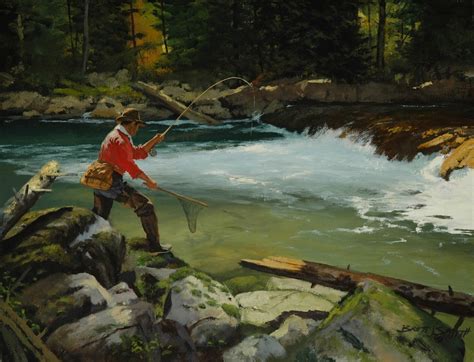


Something like this....

The scene mesmerized Matt, and he bargained with is dad to get a fly rod. This started him on the road he travels today. 

To hear Matt tell the story and talk about the first fly with which he caught a trout, check here:

Savage Flies - Matt Gets His Start

My Own Story
Well, Matt's tale made me think of my own first fish on the fly. It was a happy accident for me; I didn't bargain or organize my way into the World of the Fairy Stick.

Instead, I stumbled into it.

But that first fly-caught fish seems to be a pivotal moment for all fly anglers, and I'm no exception. 

Never a Fly Fisher

I started fishing when I was around 6 years old. Sea fishing, fresh water, north-south-east-west... I've traveled, and I've done a lot of it over the years.
But in all that time
. I never tried fly fishing. 


Both my dad and, later, my step-father,... each were capable fly fishers, but they never did invest that time with me.
Before you think they were bad fathers, let me stop you: they were not.
We did every other kind of outdoors thing together.

Camping, fishing, hiking, hunting, shooting, you name it.
For example, I was trained by my father to shoot a gun when I was 5... if I said that anywhere but here, 
people would lose their minds.
It's j
ust that fly fishing never entered the picture.

My biological father passed away when I was 12, and all his stuff was adopted, and 
appreciatedby my step father when my mom re-married.

I was far from home at that time, so he was next in line to use it.

In time, my step dad got old, too, and moved to a senior's apartment complex. By then, Life had brought us all back together, and the hoard of goodies from TWO 
old-school outdoorsmen came to me.
It was treasure trove!


The First Fly
I was like a kid in a candy shop,... a little overwhelmed and clueless about some of it, but feeling blessed.
And there, among all this bounty, I found a small metal 
fly box.


The Fly Box


What Remains


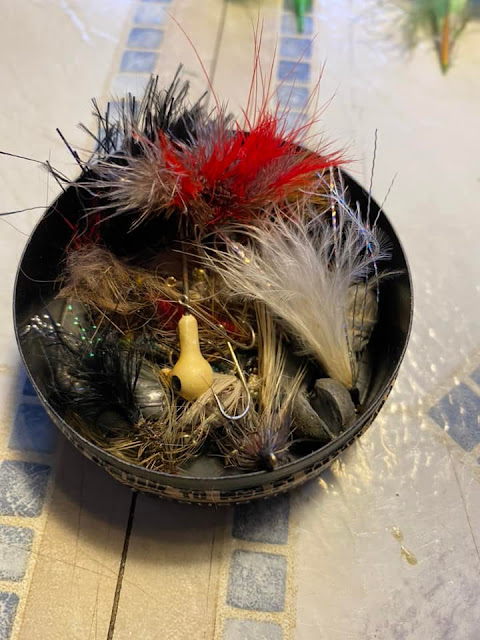
Inside, was an assortment of tattered, age-worn flies. Most of them had lost their dressing, and they held no significance - little more than fuzzy hooks. So I took them out.

What you see here is what remains.


And although I knew these things were intended to catch fish, I could tell you no more than that.


But among the remnants, I spotted a fly that stood out - mostly because it had some little antennas on it. 

That’s all I knew at the time... it appeared to be intact, it was strange looking, and it had antennae.

And antennae are friggin cool. 

More about it in a minute.


What to DO?
Here I was, the proud owner of a vintage fly box and some flies... and I had no experience at all with fly fishing.
Moreover I had no fly fishing gear.

I was in a pickle!

But, what I did have was a lot of fishing equipment, and lo and behold, I had a pond at my disposal!
My neighbors, Mark and Joanne (RIP) Goodson, had given me free run of their pond, and an open invitation to fish there any time. And that pond had fish in it….


So, I did what you might expect in that situation:

I improvised!

Ok, I had no fly rod..., but I had a collection of 
telescoping crappie poles.
Nowadays we have the Cult of Tenkara and their highfalutin' little poles-without-reels.
But, I had never heard of that, back then.
What I had was some line, and some crappie poles.
So, I did what any county boy would do - the line was tied to one of my "redneck tenkara rods," the w
eird little fly was tied on the end of that.... and I whipped it out into the water as best I could.

Which is to say, pretty poorly. But, it got out far enough... and a fish took it with a vengeance! 
As you might expect, a fat bluegill was my reward.
Despite all the odds stacked against me, I had caught my first fish on a fly... a bluegill.


The Fly
On that fateful day, all I knew was that a bluegill greedily snatched my fly from the pond's surface.
I didn't know why it wanted to, and I couldn't even imagine what the fly was; it was just an odd little thing, with antennae. 
It was only much later that I learned it was a, "G&H Sedge."


G & H Sedge, aka, "Goddard Caddis"


The Real Thing


My G & H Sedge


This pattern is a fiddly deer hair and hackle creation, intended to mimic a caddis fly.
Okay, right.... a what? A caddis fly?
I had no idea what a caddis fly was, and even today, I aint all that sure.

I don't even know who tied my sedge...someone in the past is all I know.

But it worked, and this led me to research...


The G & H Sedge
This pattern was developed 
as a stillwater trout pattern in the early 1960's, give or take, by a couple of Englishmen, John Goddard and his friend, Clive Hendry. 

They conceived it to be tied of spun deer hair, then to be trimmed into a caddis shape. 

Especially desired was the thick deer body hair, because it is very buoyant.

According to one report, they told their friend, Andre Puyans, about it, and he took it under his wing

In Britain, the fly came to be known as the, "G&H Sedge."
It had an olive seal's fur belly and the hackle was trimmed on top.
Andre had a fly shop near San Jose, CA, from which he introduced the fly to Sierra fishermen in the West, as the "Goddard Caddis"...and this name became the more popular of the two.

Because of the buoyant hair construction, it floats like a cork, and it is still well regarded as a fast water pattern.

In slower waters, the fly can create a realistic wake when skated on the surface.
This is what the real caddis does - it emerges at the surface and quickly tries to swim to the bank for safety. This leaves a telltale wake that fish recognize, and "skating" it is one of the most enjoyable ways to fish it.

Most surprising to me, though, was learning that bluegill and trout eat the same things...like caddis flies. The specific species may differ, but a caddis is a caddis the world over.
Like most people, I always pictured fly fishing as specific to trout. Yet, here I was catching bluegill on a trout fly... and I've called these scrappy little fish, "Dixie Trout" ever since. 


That also rocketed the once lowly bluegill into the highest esteem… and launched my love of fly fishing, and especially the sublime art of chasing bluegill on the fly.


So, do what I did - get you some trout flies, the rod of your choice, and go find out for yourself!

And if one of those flies is a Goddard Caddis… so much the better!

 Thanks for reading and Tight Lines

David

Palmetto Fly N Fish
I hope you enjoyed this and learned something; if you did, please share it with your friends.


References

https://flyfishingthesierra.com/godcad.htm

https://globalflyfisher.com/video/goddard-caddis-4

http://opff.org/a_goddard-caddis.php

https://www.flyfishersinternational.org/Portals/0/FlyoftheMonth/PreviousIssues/2020-02_February_GoddardCaddis_sm.pdf?ver=-xYK-YxvswBW1qS_fssaUw%3D%3D

all rights reserved © 2022


Sunday, February 6, 2022

HOBBY LOBBY FEATHER PICK CHALLENGE, fLY #1

FEBRUARY 6, 2022

If you’ll remember, I did a post last week about the feather pick I got at Hobby Lobby,... and the challenge I set for myself with that item:

Challenge - Tie as many different flies as I can from the feathers on the pick.

(If you don’t remember that, or, if you're wondering what I mean when I say, “feather pick,”…well, you can find that here: HOBBY LOBBY FEATHER PICK CHALLANGE

Review that, and this will make more sense).

Today, I knocked out the first fly for this challenge.
Although I've had a week to think of something to tie, I was still unsure what I was going to do at the vise.
So, I went to my reject box, looking for ideas.

Inspiration 101
If you've been tying flies for even a little while, you no doubt have a "reject box." As the name implies, this is the place where your less-than-perfect flies go to be forgotten.

Well, I keep mine handy and I use its contents for inspiration, or I strip and reuse the hooks.... whatever.
You get the idea.

In my case, I possess a large 'reject box' on a shelf, with several years worth of flies - and then there is a smaller one close at hand on my tying desk.

This handy one is for the "everyday rejects," - it is just a chewing tobacco tin I found floating in the water. Some people would call it a "dip can."
Yes, people are slobs, and they toss these tins wherever they go.

Jackasses.


But I collect em when I see them, clean em out, and put them to some use.


Yes, friends, I'm a tobacco tin cleaning, re-using kinda guy. 


Tobacco Tin Reject Box

Start With The Hook
When I popped the top on the reject container this morning, a big, bass fishin' worm hook fell out on the desk. Taking that as an omen, and since the feather pick has mostly large feathers on it, I went with that.

With hook in hand, I went straight to my trusty 3-Way Fly Concept*, and let things develop from there.
This is freestyling, folks!

-------------------------------
* 3 Way Fly Concept

- Tail
- Body
- Head/Hackle

1 tail + 1 body + 1 head/hackle = 3 Way Fly!

--------------------------------

SO... what fly did we get? Drumroll, please...........

FEATHER PICK CHALLENGE FLY # 1


Dressing
Hook - Offset Soft Plastic Worm Hook, size 3/0 black, unknown brand

Eyes - lead dumbbell, chartreuse

Under tail - Marabou fluff from feathers

Flash - Angel Hair tinsel

Outer tail - two ragged pick feathers, tied splayed

Body - metallic green, craft pipe-cleaner

Head - Hackle from feather pick

Topping - Pheasant tail fibers from feather pick

As you can see, this one developed a cartoonish, Roger Rabbit vibe...kinda cool.

At first I thought the tail might be too long, but, its proportional - tied to the length of the overall hook.

This beast is heavy, though, and I don't have a 12 wt fly rod that can handle it.... and no, I'm not going to run out and buy one.
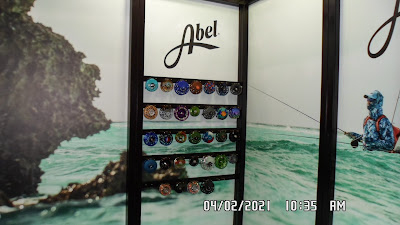
Remember, I was at the Fly Fishing Show in Atlanta the other day - I saw how much those things cost!!
So don't go there.

When I fish it, I expect I'll drag it along the bottom on a light spinning rig.
More on that, later. Stay tuned.

----------------------------------------------------- 

Thanks for reading. 
I hope you liked this, I hope you learned something, and I hope you'll share it with your friends.

Tight Lines,

David
Palmetto Fly n Fish

Opinions? Feedback? Let it rip in the comments.
And don't forget to visit us on our Facebook group: 
Palmetto Fly N Fish

All rights reserved © 2022 David Hutton, Palmetto Fly N Fish
Reproduction for other than personal use is strictly prohibited.

FLY TYING CHALLENGE: HOBBY LOBBY FEATHER PICK

February 1, 2022


This is a $2.99 “feather pick” from H-L.
It’s just a few bunches of dyed feathers affixed to a steel wire, "pick."
It is used in floral decor, as far as I know.
But, it has feathers, so……. The Challenge The aim here is to purchase one of these at random, break it down to its component parts, and make as many different flies from it as one can think of.


Here you an see it disassembled, and this is what you get (L to R)
  • Pheasant Tail
  • 1/16” paper-wrapped steel wire
  • Large, scruffy saddle feathers
  • Marabout fluff still attached to the feathers
  • Raggedy, mixed schlappen
  • Waste (at top, right)
Common, non-feather materials may be used in the challenge, but each fly MUST use some part, or all, of the feather pick elements.
Any kind of fly is allowed in the challenge - nymph, streamer, popper, etc.

More to come. Stay Tuned. Thanks for reading and, Tight lines

David

Palmetto Fly N Fish ©All Rights Reserved, David Hutton, Palmetto Fly n Fish Reproduction for other than personal use is strictly prohibited

Saturday, February 5, 2022

Fly Fishing Show Atlanta: The Pilgrimage

Feb 4, 2022
Gas South Arena, Duluth, GA

Distance: 200 miles
$5 parking fee
$15 Cover Charge

The Trip
It starts to rain. Wet, sloppy rain...the kind of weather that makes you question the wisdom of taking a 200 mile drive.
But then you look at each other and ask, "How many fly fishing shows do we get around here, after all?!
And i
t's only rain... we can always turn around.
Besides, you'll never catch a fish - or see a fly fishing show - if you wait on the weather."

So we pull up our collars, hop in the truck, and head west from Lexington, SC

At the wheel is Don Schmotzer.

Don has his own airplane, a classic, 1948 Luscombe. And he drives his truck like he's flying the plane. 


Our Pilot

As we motor along, he keeps up a steady commentary about the route conditions, time to next turn, distance traveled, trucks half a mile ahead, fuel consumed per hour, and so on... its very comforting to ride with someone with that much situational awareness.

As for me, well, I didn't realize it's almost 3 hours to Atlanta from Columbia, SC. 

I take liberal piss breaks when I drive...but pilots don't have that luxury when in the air, and they don't...  so, lemme just say, if you ever plan to ride along with someone who is a pilot, keep that in mind. 

The Arrival
"The Fly Fishing Show" goes around the country as a sort of promotional tent-show, bringing industry moguls, manufacturers, pitch men, travel brokers, and other players into one large venue.
The show's Atlanta stop is at the 
Gas South Arena, part of the "
Gas South District" - a 118-acre campus just outside of the city that accommodates events like concerts, trade shows, conventions, etc.

Being two old country dudes at heart, we get a little twitchy around this kinda big city venue.

Urban traffic crammed in like ants, notoriously bad Atlanta drivers, and paying to park in a cramped, 5-story parking garage - none of it is our cup of tea. 
Then, we're hit with a $15 entrance fee at the door.

Well, if you haven't figured it out by now, fly fishing is like anything else: you aint gettin' into it for free.

Whats Inside?
Once you enter the arena, you find 
a big open area, filled with booths and kiosks.
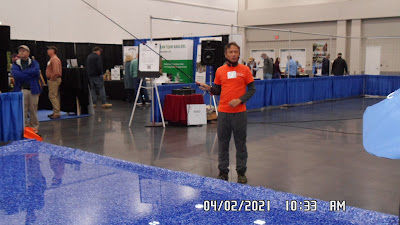
Two rectangular casting pools dominate the floor to each side of center.
All around, you see a lot of 
beards, logo ball caps, and tattoo'ed hipsters...., the cool dudes tellin' each other what they think they know about fishin'. 

Older, middle aged men 
mingle around the booths with the upstarts. They're sporting their regalia, too: khakis and $100 “technical shirts.” They're also talking fishing, but with less hormonal flow...theirs is a more studied, cerebral approach to this business.

The Hucksters are there, selling trips to faraway places.
Manufacturers offer an infinite variety of dazzling, slick rods and reels, all marked with "bargain" prices.
They have fly lines, of course, selling for $30... or $129; take your pick.
There's fly tying equipment, materials, fishing apparel, gadgets, and even boats. All at "show prices...." although you're never sure just what that means. 
But that doesn't matter, because this is a fly fishing extravaganza
.
Your eyes glaze over - you reach for your wallet. 

Further along, there is a big-screen tying demonstration, and down there, some guy with a headset is talking to the crowd about fly casting, while flailing away at the casting pool.
 
In the sub-title, I referred to this as a Mecca-like pilgrimage. But, in fact, this year's show was a shadow of it's former self - about 2/3 the size of previous years.
There was a slightly unfinished feel to the thing; thrown together at the last minute, maybe.
According to the event director that I spoke to, this isn't far off. There was a good bit of effort to get this much going.... the threat of another Covid lockdown hung over the planning, all the way to the deadline.


Throwin' flies and tellin' lies.


"We have flies and gear..."


Today's HOT deal is...


Lotsa technical advice is given..
"If you wanna catch purple spotted char and grackle-fish, you're gonna need that reel AND this one"


A gear geeks Nirvana


I don't know if I need it, but I'm sure I gotta have one


You say you want a fly tying vise?


What's that?... You want some tying materials to go with that vise?


Casting flies is easy - just do what I show you

For me, the best part of all this - the reason I really want to go - is the chance to meet different people.
Some I may only know from Facebook, or Youtube.
In other cases, its the chance to meet those I don't know - the famous, and not so famous alike.
I always pick up a few ideas, too, and swap my own BS with some genuine guru's in this business.


The fly tying instruction area has the
newcomers taken care of 


A younger lad learns the
finer points of casting, first hand. 


Guru's


John Robbins, Ph.D, Carolina Fly Fishing Club
www.carolinaflyfishingclub.com


Tim Flagler, Tightline Video Productions
www.tightlinesflyfishing.com


 Peggy Brenner
past President of International Women’s Fly Fishers


Son Tao, aka "Top," MSgt., United States Army
Aventuron Ambassador

@ Son_Tao 


Glen Populorum, all the way from Chicago-land!
self-employed automotive mechanic: Glen Populorum

An End...for now
By the time you see this, the Fly Fishing Show Atlanta will be in the books. It was great experience, although it brings the usual regret: I run my mouth so much, I inevitably miss many things - and some people. 
Sorry, Gerry Korzi.

But there's next year, God willing. 
So fingers crossed until then.

Thanks for reading.
I hope you liked this, I hope you leaned something, and I hope you'll share it with your friends

Tight Lines,

David
Palmetto Fly n Fish

Opinions? Feedback? Let it rip in the comments.
And don't forget to visit us on our Facebook group: 
Palmetto Fly N Fish

All rights reserved © 2022 David Hutton, Palmetto Fly N Fish